
Analysis of Controlled and Counterfeit Substances Using the JASCO PR-1w Palmtop Raman Spectrometer
June 12, 2026
 Download This Application
Introduction
Rapid, non-destructive identification of unknown powders and suspected counterfeit pharmaceutical samples is important in forensic, pharmaceutical, and field-screening applications. Raman spectroscopy is well suited for this purpose because it can provide molecular fingerprint information with minimal sample preparation.
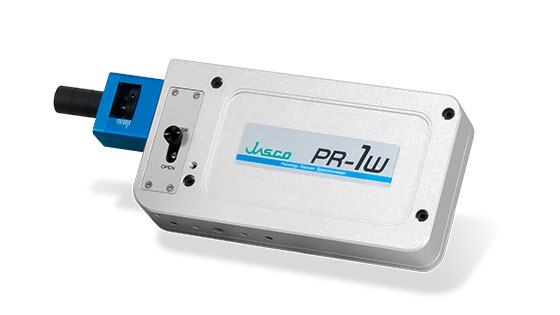
This application note describes the use of the JASCO PR-1w Palmtop Raman Spectrometer for the identification of controlled-substance mixtures and counterfeit pharmaceutical samples. The examples include a mixture containing cocaine, caffeine, and lidocaine; a counterfeit clonazepam sample containing lactose; and a fentanyl-containing mixture. The data was measured at the Instituto de Ciencias Forenses de Puerto Rico.
Experimental
Suspected controlled-substance and counterfeit pharmaceutical samples were analyzed using the JASCO PR-1w Palmtop Raman system. Raman spectra were collected directly from the samples and compared against reference spectral libraries using database-search algorithms.
Sample
Three representative samples were evaluated:
- Mixture of cocaine, caffeine, and lidocaine
- Counterfeit clonazepam sample containing lactose
- Fentanyl-containing mixture
Spectral identification was performed using library-search tools, mixture analysis, and targeted search methods where required.
Measured Protocol
The general measurement workflow was as follows:
- Place the powder or sample material in the appropriate sample holder or vial holder.
- Position the sample using the PR-1w accessory holder or Z-stage unit.
- Acquire the Raman spectrum using the PR-1w Palmtop Raman spectrometer.
- Process the spectrum using spectral-search software.
- Compare the measured spectrum with controlled and prescription drug Raman spectral libraries.
- For mixtures, apply suitable search algorithms such as first-derivative Euclidean distance and mixture-search analysis.
- For samples with strong matrix interference, perform targeted analysis or spectral subtraction when required.
- Confirm the presence of target compounds based on spectral match quality and interpretation of major Raman bands.
System
Instrument: JASCO PR-1w Palmtop Raman Spectrometer
Recommended configuration:
| Part Number | Description |
|---|---|
| 7201-J003A | PR-1w Palmtop Raman |
| 7201-J105A | PR-1-Z Z-stage unit for PR-1w Raman spectrometer |
| 7201-J101A | PR-1-V Vial holder for PR-1w Raman spectrometer |
| 7201-J106A | PR-1-SP-5 Liquid/powder holder, 5 sample positions |
| 7201-J114A | PR-1-OL22 Long working distance lens, W.D. = 22 mm |
| 022905-01 | KnowItAll JASCO Analytical Edition, including media pack |
| 978EALDB01460 | Raman - Sadtler Controlled & Prescription Drugs 1, Wiley, 855 spectra |
| 978EALDB01477 | Raman - Sadtler Controlled & Prescription Drugs 2, Wiley, 1000 spectra |
Parameters
The following analysis parameters were used or are recommended for this type of application:
| Parameter | Description |
|---|---|
| Measurement technique | Raman spectroscopy |
| Instrument type | Portable / palmtop Raman spectrometer |
| Sample type | Powder, pharmaceutical tablet material, or unknown forensic sample |
| Sample preparation | Minimal; direct measurement where possible |
| Sample holders | Vial holder, liquid/powder holder, or long working distance lens |
| Search method | Library search, mixture analysis, targeted compound search |
| Algorithm used | First-derivative Euclidean distance for mixture identification |
| Database | KnowItAll JASCO Analytical Edition with Wiley controlled and prescription drug Raman libraries |
| Data treatment | Mixture search, spectral subtraction, targeted search where needed |
Specific acquisition settings such as laser power, exposure time, accumulation number, and spectral range were not listed in the provided report and should be added when finalizing the validated method.
Results
Sample 1: Mixture of Cocaine, Caffeine, and Lidocaine
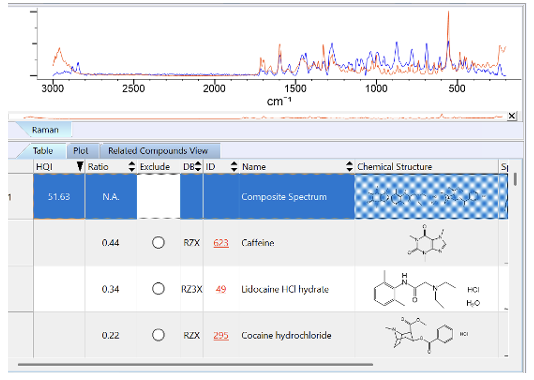
The Raman spectrum of Sample 1 was successfully analyzed as a multi-component mixture. Using a search algorithm based on first-derivative Euclidean distance, the sample was identified as a mixture containing cocaine, caffeine, and lidocaine.
This result demonstrates that the PR-1w Palmtop Raman system can identify multiple components in a complex powder sample when paired with an appropriate spectral-search algorithm and reference database.
Sample 2: Counterfeit Clonazepam
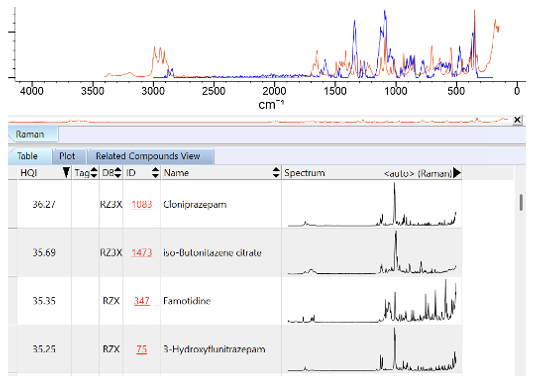
Sample 2 was analyzed as a counterfeit clonazepam sample. Initial spectral interpretation indicated the presence of lactose, which can act as a major excipient and may mask weaker spectral features from the active pharmaceutical ingredient.
After lactose subtraction, clonazepam became detectable in the sample. This result shows the importance of spectral subtraction and mixture interpretation when analyzing counterfeit pharmaceutical samples. Even when the target compound is not the dominant component, Raman spectroscopy can support identification if the proper data-processing workflow is applied.
Sample 3: Fentanyl-Containing Mixture
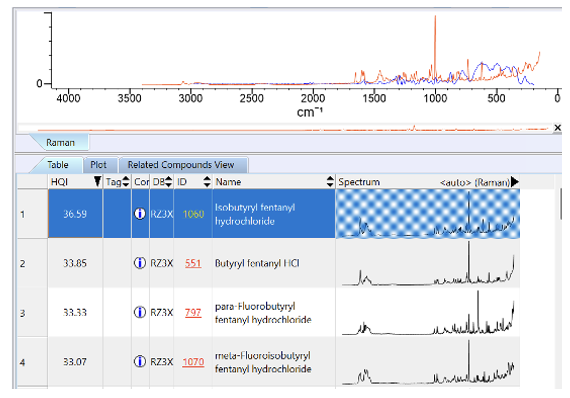
Sample 3 was analyzed using a targeted search approach to determine whether fentanyl was present. Fentanyl was identified; however, the analysis was more challenging because the fentanyl concentration appeared to be low and fluorescence from other sample components interfered with the Raman signal.
This example highlights both the strength and limitation of Raman spectroscopy. The PR-1w system was able to support fentanyl identification, but low concentration and fluorescence interference can reduce spectral clarity. In such cases, targeted search methods, optimized acquisition conditions, and confirmatory laboratory testing may be required.
Keywords
Palmtop Raman, forensic analysis, controlled substances, counterfeit pharmaceuticals, cocaine, caffeine, lidocaine, clonazepam, lactose, fentanyl, targeted Raman search, KnowItAll database, mixture analysis
Conclusion
The JASCO PR-1w Palmtop Raman Spectrometer successfully identified controlled and counterfeit-substance samples, including:
- A mixture of cocaine, caffeine, and lidocaine
- A counterfeit clonazepam sample containing lactose and clonazepam
- A fentanyl-containing mixture using targeted Raman analysis
These results demonstrate that palmtop Raman spectroscopy can be a useful rapid-screening tool for forensic and counterfeit pharmaceutical applications. The combination of portable Raman measurement, spectral libraries, mixture-search algorithms, and targeted analysis provides a practical workflow for identifying unknown or complex samples with minimal sample preparation.