
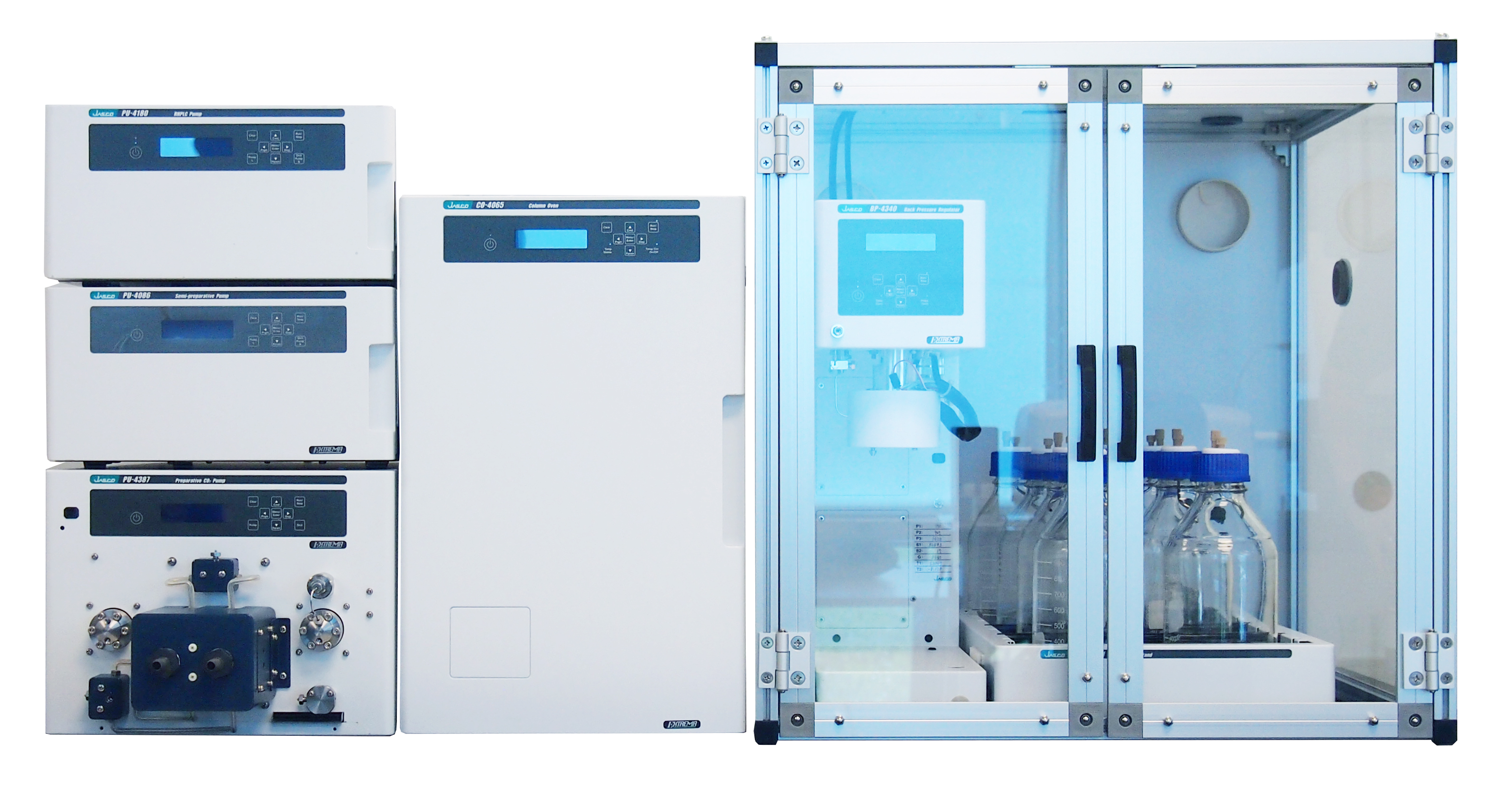
JASCO SFE-4000 supercritical fluid extraction (SFE) systems use supercritical carbon dioxide (CO₂) to selectively extract target compounds from a wide range of sample matrices. Analytical, hybrid, semi-preparative, and preparative configurations provide flexibility for method development, analytical, and scale-up for larger volume extractions, with extraction vessels up to 2 L and CO₂ flow rates up to 150 mL/min. Flexible system configurations accommodate different sample volumes, extraction methods, and collection requirements.
What is Supercritical Fluid Extraction (SFE)?
Supercritical fluid extraction (SFE) uses a supercritical fluid, a substance above its critical temperature and pressure, as the extraction solvent. Carbon dioxide (CO₂) is widely used in SFE because its critical point can be reached at relatively moderate operating conditions (31.1°C and 73.8 bar). The low liquid-like viscosity and high gas-like diffusivity of supercritical CO₂ enables rapid penetration into porous samples for efficient extractions. Supercritical CO₂ is particularly useful for nonpolar and moderately polar compounds. Extraction selectivity can be adjusted by changing pressure and temperature or by introducing a co-solvent (also known as a modifier) such as ethanol or methanol. This provides additional flexibility for extracting more polar compounds and optimizing methods for different analytes and sample matrices.
Supercritical Fluid Extraction (SFE) System Components
A supercritical fluid extraction (SFE) system combines precise fluid delivery, temperature and pressure control, extraction vessels, and collection support for efficient, reproducible extractions.
The key system components and their functions are outlined below:
- CO₂ pump: Provides controlled flow of liquid CO₂ to the extraction system.
- Co-solvent pump: Introduces modifiers to adjust extraction selectivity, improve solubility, and extend SFE to more polar compounds.
- Extraction vessel: Holds the sample at the selected extraction pressure and temperature. Extraction vessel size depends on the required extraction scale.
- Extraction oven: Controls extraction vessel temperature to help maintain supercritical conditions.
- Back pressure regulator (BPR): Controls system pressure to help maintain supercritical conditions.
- Fraction collection: Collects extracted compounds for subsequent analysis or processing.
- Software: Supports automated extraction method development and fraction collection while monitoring and storing flow rate, pressure, and temperature data.
Advantages of Supercritical CO2 Extraction
- Tunable Selectivity – Pressure, temperature, and co-solvent composition can be adjusted to change extraction selectivity and target compounds of interest while minimizing unwanted matrix components and post-extraction cleanup.
- Reduced Solvent Removal – CO₂ returns to a gas during depressurization, reducing the amount of liquid extraction solvent that must subsequently be removed.
- Faster Extraction – The low viscosity and high diffusivity of supercritical CO₂ reduces the extraction time compared to solvent extractions.
- Higher Yields – Supercritical CO₂ can penetrate sample matrices and provide increased surface area contact with target compounds.
- Lower Operating Cost – The cost of CO₂ is significantly less than the equivalent amount of organic solvent required for liquid extractions.
- Environmentally Friendly – Lower organic solvent consumption reduces the amount of waste disposal.
Limitations and Considerations
Supercritical CO₂ extraction offers selective recovery and faster extraction over liquid extractions; however, several limitations and practical considerations should be evaluated when selecting and developing methods for your target compounds and sample matrix.
- Polarity and Solubility: Supercritical CO₂ is best suited for extracting nonpolar to moderately polar compounds. Adding co-solvents adjusts its solvent strength and broadens the range of compounds that can be extracted.
- Equipment Cost: SFE systems typically require a higher initial investment than conventional solvent extraction equipment; however, lower solvent consumption and waste disposal costs can help offset this expense, with the return on investment depending on sample throughput and operating conditions.
- Sample Preparation: Particle size and extraction vessel packing influence sample flow path and extraction efficiency. It is important to control the amount of moisture in the sample to prevent freezing during depressurization.
- Operating Requirements: High-pressure operation and CO₂ handling require trained operators, appropriate safety practices, and suitable laboratory facilities.
SFE-4000 System Configurations
| System | Extraction Vessel | CO2 Flow Rate | Typical Application |
| Analytical | 1, 5, and 10 mL | 0.5 to 10 mL | Analytical extractions and method development |
| Hybrid | 10, 50, and 100 mL | 0.5 to 20 mL | Analytical extractions and method development small-scale extractions |
| Semi–Preparative | 50, 100, and 250 mL | 3 to 50 mL | Larger-scale extractions and method scale-up |
| Preparative | 500 mL, 1 L, and 2 L | 5 to 150 mL | Large-scale extractions and process development |
Safety and Compliance
Safe operation of a SFE system requires equipment rated for the intended operating temperature and pressure, reliable pressure control and relief devices, and adequate ventilation for safely exhausting CO₂. Routine inspections, preventative maintenance, trained operators, and appropriate personal protective equipment (PPE) further support safe operation. When co-solvents are used, procedures should address safe handling, exposure control, flammability, and waste disposal. Facilities should follow applicable pressure-vessel, compressed-gas, and workplace safety requirements and verify the certifications and installation requirements for their specific SFE configuration.
JASCO SFE-4000 systems incorporate several features to support controlled high-pressure operation, including CO₂ and co-solvent pumps rated to 4,351 psi (300 bar, 30 MPa), automatic stop valves that open during pumping and close when pumping stops to isolate the pumps, extraction vessels rated to 10,000 psi (689 bar, 68.9 MPa), and a back pressure regulator for controlled extraction pressure and depressurization. A fume hood helps to prevent gas accumulation during depressurization. JASCO also provides site preparation requirements before system installation and operator training by a field service engineer.
Scalability and System Upgrades
JASCO SFE-4000 systems provide a flexible path from analytical method development to preparative supercritical CO₂ extraction, supporting vessel sizes up to 2 L and CO₂ flow rates up to 150 mL/min. Developing methods at a smaller scale helps conserve samples and resources while extraction conditions are optimized before moving to larger sample sizes. Scale-up can then be achieved by increasing the extraction vessel size and CO₂ flow rate appropriate for the sample size.
The modular platform can accommodate changing workflow and throughput requirements.
Additional accessories can be incorporated into the configuration, including automatic switching of six co-solvents and six extraction vessels, automatic open-bed and/or closed-bed fraction collection, and a make-up pump to help reduce precipitation. Contact your local JASCO sales representative to explore an SFE configuration that meets your laboratory’s current requirements while providing flexibility for future growth.
Cost and Environmental Impact
SFE reduces reliance on hazardous organic solvents, helping lower solvent purchasing and waste disposal costs while reducing environmental impact. While SFE systems require a higher initial investment in high-pressure equipment, these operational savings help offset the cost. Return on investment and environmental impact will depend on the application, system configuration, sample throughput, extraction conditions, CO₂ and co-solvent consumption, maintenance requirements, and energy consumption. The environmental footprint can further be reduced by sourcing CO₂ reclaimed from industrial by-product streams and recycling CO₂ after extraction instead of venting.
Frequently Asked Questions (FAQs)
- What solvents other than CO₂ can be used in SFE?
CO₂ is the most widely used supercritical fluid for SFE because of its relatively accessible critical point, nonflammability, and low cost. In supercritical CO₂ extraction, co-solvents, also called modifiers, adjust solvent strength and expand the range of compounds that can be extracted. Depending on the application and system compatibility, options include nonpolar solvents such as hexane and toluene, polar aprotic solvents such as acetonitrile and ethyl acetate, and polar protic solvents such as ethanol and methanol. When extraction conditions and solvent compatibility permit, small amounts of water may also be added to an alcohol modifier to improve the extraction of highly polar compounds. These co-solvents do not need to reach their individual supercritical conditions. Instead, they alter the solvent properties and phase behavior of the CO₂ mixture, which must be considered when selecting the extraction temperature, pressure, and solvent composition. - Does SFE leave solvent residues in the final product?
Supercritical CO₂ extraction can produce extracts without residual organic extraction solvents when CO₂ is used alone. As pressure is released, CO₂ returns to a gas and separates from the extract, eliminating the need for lengthy solvent evaporation or drying. Adding co-solvents, such as methanol, can improve the extraction of polar compounds but may leave residual solvent in the extract. Additional solvent removal and testing may be needed to meet product purity specifications and applicable residual-solvent limits. - Is supercritical CO₂ extraction safer than extraction with organic solvents?
Supercritical CO₂ extraction offers several safety advantages over conventional organic solvent extraction. Because CO₂ is nonflammable, using it in place of flammable organic solvents can reduce fire hazards and exposure to hazardous solvent vapors. Safe operation still requires properly rated high-pressure equipment, trained operators, and adequate ventilation to prevent hazardous CO₂ accumulation. Adding organic co-solvents can improve the extraction of polar compounds but introduces additional flammability and exposure risks that require appropriate handling and safety precautions. - Can an SFE method scale from analytical to preparative scale?
Yes, SFE methods can be scaled from analytical method development to the preparative scale while retaining the same underlying extraction principles. Scaling typically involves larger extraction vessels, higher CO₂ flow rates, and optimization of operating conditions to maintain extraction efficiency and product quality. The SFE-4000 series supports analytical through preparative extraction, with extraction vessel sizes ranging from 1 mL to 2 L.
Proven Across a Wide Range of Applications
SFE is an established technique across food, nutraceutical, and industrial processing, including omega-3 (EPA/DHA) purification from fish oil, flavor and fragrance extraction from botanicals, and vegetable oil refining for compounds like vitamin E. See our full breakdown of supercritical CO₂ applications by industry for the complete list.
The application notes below demonstrate the versatility of the SFE-4000 Series through real-world examples.