
Base Material and Dye Analysis – Combined Raman and Infrared Spectroscopy Analysis
May 29, 2026 Download This Application
Introduction
Both Raman spectroscopy and infrared spectroscopy provide molecular structural information based on vibrational transitions, and the information obtained from the two techniques is complementary. Raman spectroscopy is particularly suitable for analyzing inorganic substances because measurements can be performed in the low-wavenumber region. In contrast, infrared spectroscopy is widely used for qualitative analysis of organic substances because extensive spectral databases are available. Therefore, the combined use of Raman and infrared spectroscopy enables comprehensive characterization of both inorganic and organic compounds.
Combined macroscopic FTIR/Raman analyses ca be performed by attaching a Palmtop Raman Spectrometer to an FTIR spectrometer equipped with an attenuated total reflectance (ATR) accessory as shown in Figure 1. This configuration enables measurements by both techniques without transferring the sample between instruments, allowing efficient and complementary analysis of the sample.
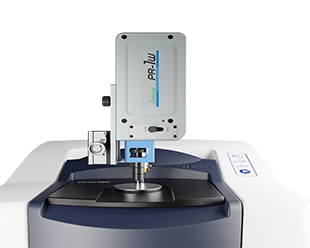
In this report, we present an example of macroscopic analysis of green embroidery thread using a combination of the Palmtop Raman spectrometer and an ATR-FTIR spectrometer. These techniques provide complementary spectral information, enabling more comprehensive characterization of the sample.
Experimental
Sample
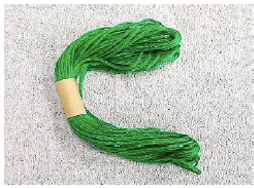
Green embroidery thread (Figure 2)
System
- Raman system
Instrument: PR-1w Palmtop Raman Spectrometer
Accessory: PR-1-ATR Mounting unit
- IR system
Instrument: FT/IR-4X Spectrometer
Accessory: ATR PRO 4X Single reflection ATR accessory
Parameters
- Raman system
Ex wavelength: 785 nm
Laser power: 50 mW
Exposure time: 2 sec
Accumulation: 8
- IR system
Detector: TGS
Crystal: Diamond
Resolution: 4 cm-1
Accumulation: 16
Keywords
Thread, dye, qualitative analysis, component analysis, combined analysis, Palmtop Raman spectrometer, ATR, FT/IR-4X
Results
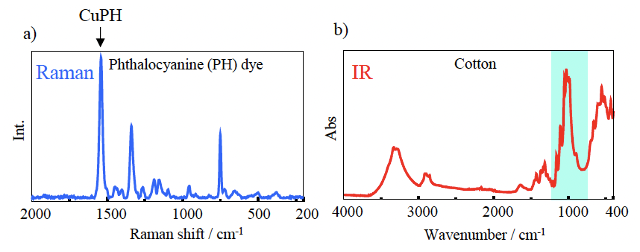
Figure 3 shows the spectra of green embroidery thread obtained using the PR-1w and the FT/IR-4X. In the Raman spectrum, a peak attributed to copper phthalocyanine (CuPH)1) is observed near 1525 cm-1 due to the resonance Raman effect, providing information about the dye used to color the thread (Fig. 3a). In contrast, the IR spectrum shows a characteristic band in the region of 800 cm-1 to 1200 cm-1 (Fig. 3b, light blue area) assigned to C-O-C vibrations in cellulose.2) Because cellulose is the main component of the cotton fibers used in the embroidery thread, the IR spectrum provides information about the fibers material. Thus combining Raman and IR measurements enables complementary characterization of the dye and fiber components of the sample.
Conclusion
Embroidery thread was measured using the Palmtop Raman spectrometer and the ATR-FTIR spectrometer. The Raman spectrum provided information about the phthalocyanine dye, an organic-inorganic complex, through the resonance Raman effect, while the IR spectrum indicated that the fiber material was cotton, an organic material. These results demonstrate that combining Raman and IR spectroscopy provides complementary information about the sample. The system used in this study is also suitable for rapid evaluation of organic-inorganic composite materials, including bio-minerals and cosmetics containing organic-inorganic components, because measurements can be performed nondestructively without specialized sample preparation, this approach is useful for efficient sample characterization.
References
- D. Antuña-Jiménez, D. Ibáñez, M. B. González-García, D. Hernández-Santos, P. Fanjul- Bolado: Sensors (Basel), 20, 3702 (2020). DOI: 10.3390/s20133702
- M. F. Rosa, E. S. Medeiros, J. A. Malmonge, K. S. Gregorski, D. F. Wood, L.H.C. Mattoso, G. G l e n n , W. J. Orts, S. H. Imam: Carbohydr. Polym., 81, 83 (2010). DOI: 10.1016/j.carbpol.2010.01.059