
Rapid Screening of Flurbiprofen and Ketoprofen using an SFC–PDA Method Scouting System with 10 Columns and 3 Solvents
November 3, 2026 Download This Application
Introduction
Supercritical fluid chromatography (SFC) uses a supercritical mobile phase primarily composed of carbon dioxide. The low viscosity and high diffusivity of the mobile phase enable SFC to maintain high separation efficiency at high linear velocities, making it well suited for rapid chiral separations. Developing these separations often involves screening multiple columns and modifier solvents to identify suitable selectivity and resolution. Chiral columns packed with 3 µm particles offer the potential for faster, more efficient separations than conventional 5 µm columns.
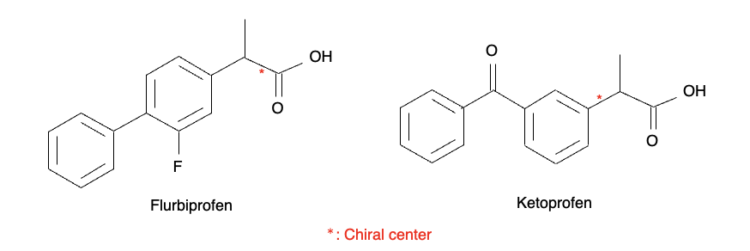
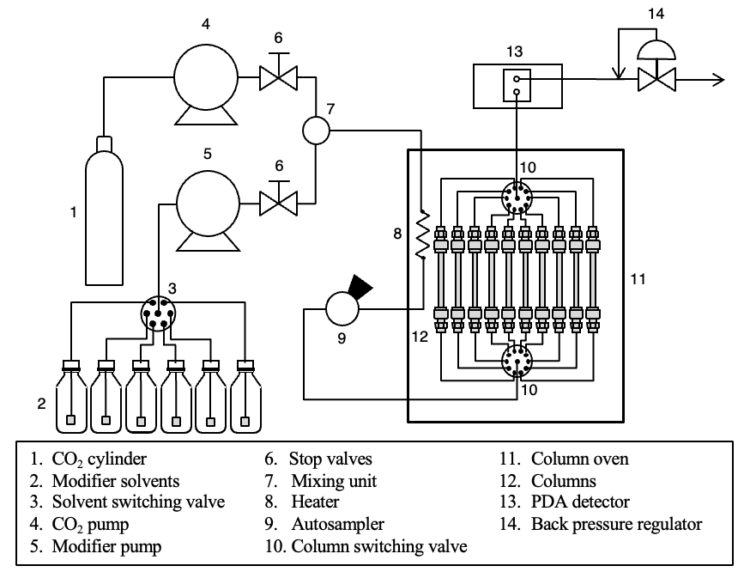
In this application note, flurbiprofen and ketoprofen, two acidic nonsteroidal anti-inflammatory drugs (NSAIDs), were screened using a JASCO SFC system equipped with a photodiode array (PDA) detector and the Method Scouting Support Program, an add-in software for ChromNAV Ver. 2. Screening ten chiral columns packed with 3 µm particles and three modifier solvents enabled rapid identification of suitable conditions for the enantiomeric separation of acidic compounds without the use of additives, such as trifluoroacetic acid.
Experimental
Instruments
CO2 pump: PU-4380
Modifier pump: PU-4185*
Autosampler: AS-4350
Column oven: CO-4065*
Detector: MD-4010
BP regulator: BP-4340
*with option units
LC Conditions
Column: CHIRALPAK IA/SFC, IB-N/SFC, IC/SFC, ID/SFC, IE/SFC, IF/SFC, IG/SFC, IH/SFC, IJ/SFC, IK/SFC
(3.0 mm I.D. x 50 mm L, 3 µm)※
Eluent: Carbon dioxide / modifier (75 / 25)
Modifier: A; Methanol, B; Acetonitrile / ethanol (80 / 20) C; t-Butyl methyl ether / ethanol (80 / 20)
Flow rate: 1.2 mL/min
Column temperature: 40ºC
Wavelength: 210 nm (MD-4010)
Back pressure: 15 MPa
Injection volume: 1 µL
※CHIRALPAK is a trademark or registered mark of Daicel Corporation.
Samples: 0.1 mg/mL flurbiprofen in methanol
0.5 mg/mL ketoprofen in methanol
Keywords
Flurbiprofen, Ketoprofen, SFC, PDA detection, column screening, method scouting, chiral separation, CHIRALPAK, 3 µm
Results
During screening, the column equilibration time was set to 10 minutes for the first column following each modifier solvent change to allow solvent replacement throughout the system, and 3 minutes for subsequent columns. Each analysis required 3.0 minutes, resulting in a total screening time of 3.4 hours per compound.
Figure 3 and Figure 4 show the screening results for flurbiprofen and ketoprofen, respectively. Each row of chromatograms corresponds to a different modifier solvent, while each column corresponds to a different chiral column.
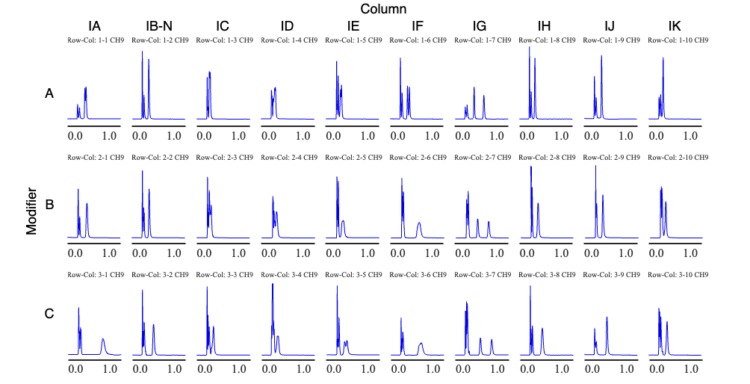
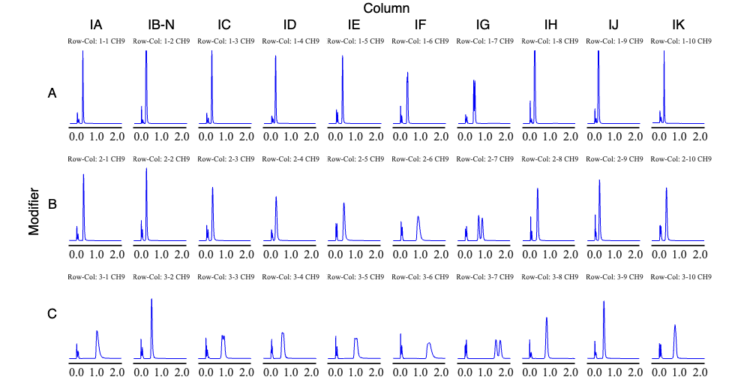
Tables 1 and 2 summarize the chromatographic resolution obtained for flurbiprofen and ketoprofen under each screening condition. Results with resolution values (Rs) ≤ 1 are designated as incomplete separation (I.S.). Good enantiomeric separation was achieved for both compounds using CHIRALPAK IG/SFC. In contrast, CHIRALPAK IA, IC, ID, IE, and IF provided only partial separation, with distinguishable peak apexes but no baseline separation.
Although acidic additives, such as phosphoric acid and trifluoroacetic acid, are commonly used for the chiral separation of acidic compounds by HPLC, suitable SFC conditions were identified for both compounds without these additives, which may be attributed to the weak acidity of supercritical carbon dioxide.
Table 1. Comparison of flurbiprofen resolution under each screening condition
| Column / Modifier | IA | IB-N | IC | ID | IE | IF | IG | IH | IJ | IK |
|---|---|---|---|---|---|---|---|---|---|---|
| Methanol | I.S. | N.S. | N.S. | N.S. | N.S. | 1.41 | 4.90 | N.S. | N.S. | N.S. |
| Acetonitrile / ethanol | N.S. | N.S. | N.S. | N.S. | N.S. | N.S. | 4.25 | N.S. | N.S. | N.S. |
| t-Butyl methyl ether / ethanol | N.S. | N.S. | N.S. | N.S. | I.S. | N.S. | 4.27 | N.S. | N.S. | N.S. |
I.S.: Incomplete Separation, N.S.: Not Separated
Table 2. Comparison of ketoprofen resolution under each screening condition
| Column / Modifier | IA | IB-N | IC | ID | IE | IF | IG | IH | IJ | IK |
|---|---|---|---|---|---|---|---|---|---|---|
| Methanol | N.S. | N.S. | N.S. | N.S. | N.S. | I.S. | 1.20 | N.S. | N.S. | N.S. |
| Acetonitrile / ethanol | N.S. | N.S. | N.S. | N.S. | N.S. | N.S. | 1.49 | N.S. | N.S. | N.S. |
| t-Butyl methyl ether / ethanol | N.S. | N.S. | I.S. | I.S. | I.S. | N.S. | 1.30 | N.S. | N.S. | N.S. |
I.S.: Incomplete Separation, N.S.: Not Separated
Conclusion
In this application note, the use of an SFC–PDA method scouting system, combined with chiral columns packed with 3 µm particles, enabled rapid screening of ten columns and three modifier solvents in 3.4 hours per compound. Suitable method conditions were identified for the enantiomeric separation of two acidic NSAIDs, flurbiprofen and ketoprofen, without the use of acidic additives, such as phosphoric acid and trifluoroacetic acid.
Conditions that produced incomplete separation have the potential to be further optimized to achieve baseline separation by adjusting method conditions, such as column dimensions, modifier solvent type, and/or modifier composition.
These results demonstrate the effectiveness of using a SFC method scouting system to quickly explore and identify conditions for chiral separations to streamline method development.