
Simple Evaluation of Quantum Yield Using the Relative Method
September 23, 2026 Download This Application
Introduction
Quantum yield is one of the key parameters used to evaluate the photophysical properties of luminescent materials. It is defined as the ratio of the number of photons emitted as fluorescence or phosphorescence to the number of excitation photons absorbed by the sample. Two methods are commonly used to determine quantum yield: the relative method and the absolute method.
The absolute method requires an integrating sphere to collect all photons emitted from the sample. In contrast, the relative method enables quantum yield to be determined more easily by comparing the fluorescence intensity of an unknown sample with that of a reference standard of known quantum yield.
In this application note, the fluorescence quantum yields of perylene and rhodamine 6G were measured by the relative method using anthracene as the reference standard.
Overview of Quantum Yield Calculation Using the Relative Method
To determine the relative quantum yield, the following parameters are required:
- The quantum yield of the reference standard.
- The absorbance at the excitation wavelength for both the reference standard and the unknown sample.
- The integrated area of the spectrally corrected emission spectrum for both the reference standard and the unknown sample.
In addition, the following parameters may be required depending on the measurement conditions:
- The average refractive index of the solvent over the wavelength range used for emission spectrum integration, when the solvents used for the reference standard and the unknown sample are different.
- The dilution factor, when the sample used for emission spectrum measurement has been diluted relative to the sample used for absorbance measurement.
Table 1. Parameters Required for Relative Quantum Yield Calculation
| Subject | Sample | Term | |
|---|---|---|---|
| 1 | Quantum yield | Standard | 𝜑𝑠𝑡 |
| 2 | The absorbance at the excitation wavelength | Standard Unknown | 𝐴𝑠𝑡 𝐴𝑥 |
| 3 | Emission area | Standard Unknown | 𝐹𝑠𝑡 𝐹𝑥 |
| 4 | Average refractive index of the solvent | Standard Unknown | 𝑛𝑠𝑡 𝑛𝑥 |
| 5 | Dilution ratio | Standard Unknown | 𝐷𝑠𝑡 𝐷𝑥 |
The following outlines the calculation procedure for determining the quantum yield of an unknown sample using the standard sample as a reference.

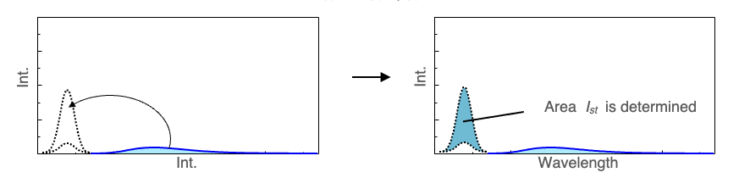
Step 1. Calculate the excitation light absorption area of the standard sample
Divide the fluorescence spectral area of the standard sample 𝐹𝑠𝑡 by the known quantum yield 𝜑𝑠𝑡 to calculate the excitation light absorption area 𝐼𝑠𝑡.
𝐼𝑠𝑡=𝐹𝑠𝑡∕𝜑𝑠𝑡
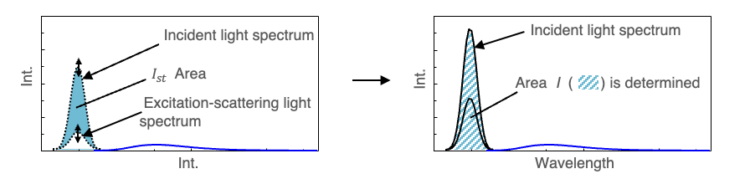
Step 2. Calculate the area of the incident light spectrum
Divide the excitation light absorption area of the standard sample 𝐼𝑠𝑡 by the absorption coefficient derived from the absorbance 𝐴𝑠𝑡 to determine the area of the incident light spectrum 𝐼. Since fluorescence measurements of solutions are generally performed under conditions where absorbance is low, the [Relative Quantum Yield Calculation] program assumes that the absorption coefficient is lineraly approximated based on the absorbance.
𝐼 = 𝐼𝑠𝑡 ∕ (1−10−𝐴𝑠𝑡) ≈ 𝐼𝑠𝑡 ∕ (2.303𝐴𝑠𝑡)
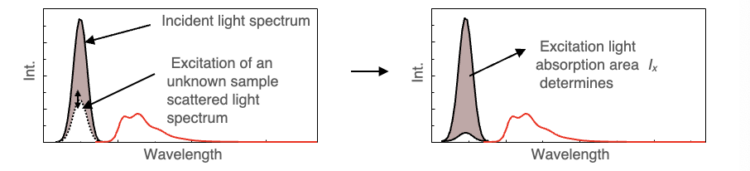
Step 3. Calculate the excitation light absorption area of the unknown sample
Multiply the area of the incident light spectrum determined in Step 2, 𝐼, by the absorption coefficient, 𝐴𝑥, to calculate the excitation light absorption area of the unknown sample, 𝐼𝑥.
𝐼𝑥 = 𝐼×(1−10−𝐴𝑥) ≈ 𝐼×2.303𝐴𝑥
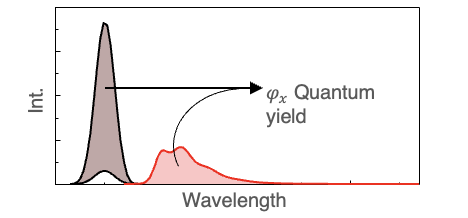
Step 4. Calculate the quantum yield of an unknown sample
Divide the fluorescence area of the unknown sample, 𝐹𝑥, by the excitation light absorption area determined in Step 3, 𝐼𝑥, to calculate the quantum yield, 𝜑𝑥. Furthermore, the procedures in Steps 1 through 3 can be expressed mathematically as follows.

If the unknown sample and the standard sample use different solvents, or if the sample used for the absorbance measurement was diluted before the fluorescence spectrum measurement, the equations are as follows.

Experimental
The literature value1) of anthracene was used as a reference to calculate the quantum yields of other fluorescent substances.
Sample
Anthracene solution (standard sample, solvent: cyclohexane)
Perylene solution (solvent: cyclohexane)
Rhodamine 6G solution (solvent: ethanol)
System
Fluorescence Spectroscopy
Equipment: FP-8550 Spectrofluorometer
Accessories: ESC-142 Light Source for Spectral Correction (WI)
Absorbance Measurement
Instrument: V-750 UV-Vis Spectrophotometer
*Measurements can also be performed using the FUV-803 absorbance measurement cell block (accessory for the FP-8050 series).
Parameters
Fluorescence Spectroscopy
Excitation Bandwidth: 5 nm
Emission Bandwidth: 5 nm
Sensitivity: 240 V
Excitation Wavelength: See Table 2
Response: 0.5 sec
Scan Speed: 500 nm/min
Absorbance Measurement
Bandwidth: 2 nm
Response: 0.24 sec
Scan Speed: 1000 nm/min
Use a U-330 filter for UV-excited samples
Keywords
Quantum yield, relative quantum yield, spectrofluorometer
Results
The measured fluorescence spectra and calculated relative quantum yields are shown below.
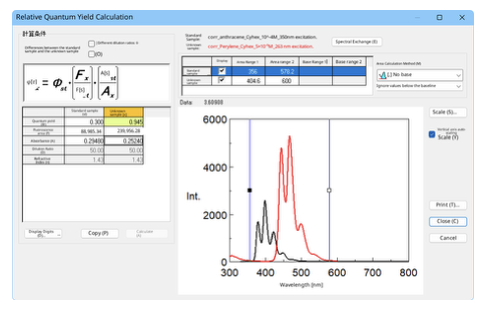
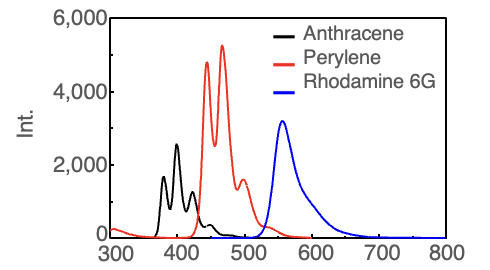
Table 2. Quantum Yield Calculation Results Using the Relative Method
| Compound | Solvent Refractive Index | Excitation Wavelength [nm] | Absorbance | Quantum Yield Calculation | Quantum Yield References |
|---|---|---|---|---|---|
| Anthracene | 1.43 | 350 | 0.2948 | -* | 0.31) |
| Perylene | 1.43 | 263 | 0.2524 | 0.945 | 0.942) |
| Rhodamine 6G | 2.36 | 488 | 0.1524 | 0.941 | 0.942) |
*In the relative method, the excitation light absorption area is calculated in reverse from the fluorescence area and quantum yield of the reference substance (in this case, anthracene); therefore, the quantum yield cannot be calculated.
The quantum yields of perylene and rhodamine 6G were calculated using a relative method based on the measurement results for anthracene. Although these three compounds have different excitation wavelengths, appropriate spectral correction allowed us to obtain quantum yields that agree well with literature values, as shown in Table 2.
Conclusion
In the calculation of quantum yields using the relative method, results equivalent to those in the literature were obtained even for samples with different excitation wavelengths or solvents. By selecting appropriate standard samples and setting appropriate measurement conditions, quantum yields can be evaluated with high reliability even using the relative method.
Nippon Spectroscopy’s spectrofluorometers come standard with a dedicated program (Fig. 3) that assists in calculating relative quantum yields; by entering the sample’s absorbance data, the quantum yield can be easily calculated.
References
- M. Montalti, A. Credi, L. Prodi, M. T. Gandolfi: Handbook of Photochemistry, 3rd ed., CRC Press, Taylor and Francis Group, 2006. DOI:10.1201/9781420015195.
- A. M. Brouwer: Pure Appl. Chem. 83 , 2213 (2011). DOI: 10.1351/PAC-REP-10-09-31.