
Analysis of Diesel Particulate Matter using UHPLC
August 19, 2022
 Download This Application
Introduction
Ultra High-Performance Liquid Chromatography (UHPLC) is a separation method that employs columns packed with sub 2 µm packing materials, offering high column efficiency even at a high mobile phase linear velocity. The typical length of commercial column is 50 mm, however, 100 and 150 mm long columns are now available, offering much higher efficiency.
In this report, one such high-efficiency column is used for the analysis of diesel particulate matter which are included in a complex matrix containing many contaminates.
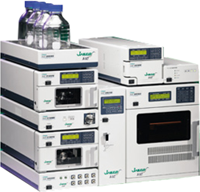
Experimental
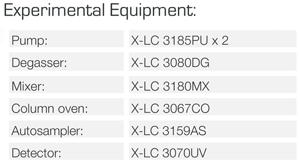
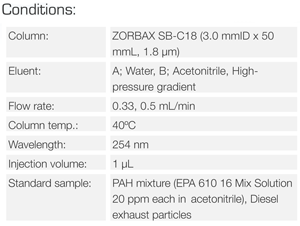
Results
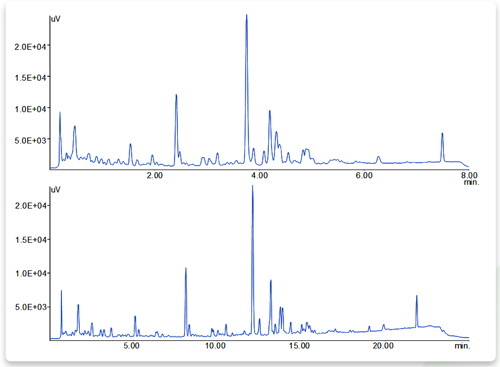
Figure 1 shows the chromatograms of the standard mixture of 16 polycyclic aromatic hydrocarbons (PAHs). The top chromatogram was obtained using a 50 mm long column, while the bottom was a 150 mm long column. Peak resolutions (Rs) between benzo[b]fluoranthene, benzo[k]fluoranthene and benzo[a]pyrene, which are known to be difficult to separate among the 16 types of components, are calculated to be Rs=1.2(Peak 1&2), Rs=1.3(Peak 2&3) for a 50 mm column, and Rs=2.0 (peak 1&2) Rs=3.1(peak 2&3) for a 150 mm column. It is apparent that a 150 mm long column offers significantly better resolutions than provided by a 50 mm long column.
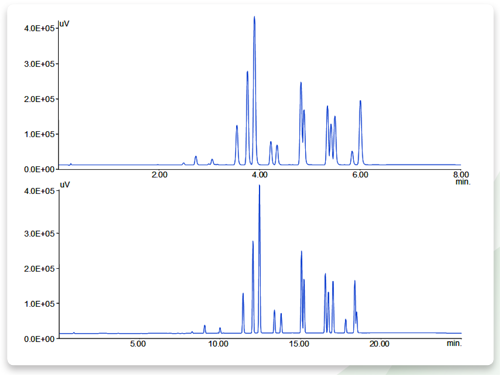
1: Benzo[b]fluoranthene, 2:Benzo[k]fluoranthene, 3: Benzo[a]pyrene
Featured Products:

Analysis of Diesel Particulate Matter using UHPLC
Introduction
Ultra High-Performance Liquid Chromatography (UHPLC) is a separation method that employs columns packed with sub 2 µm packing materials, offering high column efficiency even at a high mobile phase linear velocity. The typical length of commercial column is 50 mm, however, 100 and 150 mm long columns are now available, offering much higher efficiency.
In this report, one such high-efficiency column is used for the analysis of diesel particulate matter which are included in a complex matrix containing many contaminates.
Experimental
Results
Figure 1 shows the chromatograms of the standard mixture of 16 polycyclic aromatic hydrocarbons (PAHs). The top chromatogram was obtained using a 50 mm long column, while the bottom was a 150 mm long column. Peak resolutions (Rs) between benzo[b]fluoranthene, benzo[k]fluoranthene and benzo[a]pyrene, which are known to be difficult to separate among the 16 types of components, are calculated to be Rs=1.2(Peak 1&2), Rs=1.3(Peak 2&3) for a 50 mm column, and Rs=2.0 (peak 1&2) Rs=3.1(peak 2&3) for a 150 mm column. It is apparent that a 150 mm long column offers significantly better resolutions than provided by a 50 mm long column.
1: Benzo[b]fluoranthene, 2:Benzo[k]fluoranthene, 3: Benzo[a]pyrene