
Analysis of Ultraviolet Absorbers in Sunscreen Cream by HPLC
July 9, 2025
 Download This Application
Introduction
In 2008, Italian scientists published their results showing that oxybenzone, benzophenone and cinnamic acid, the major components of UV absorbers, are responsible for coral bleaching (i.e., death). In 2015, results showing that the chemicals affect coral DNA even at low concentrations were published in a scientific journal of Environmental Toxicology. An ordinance that bans the sale and distribution of sunscreens containing oxybenzone (HMB) and octinoxate (EMC) was enacted in 2018 and came into effect on January 1, 2021 in Hawaii. These ordinances and bills are set to come into effect at the same time in Key West, Florida and Bonaire, the Caribbean; thus, regulations have started to be taken around the world. In Japan, however, products using these components are still sold because of the absence of such regulations, and their use is not banned either. Nevertheless, we encourage to choose UV-absorber-free or environmentally friendly products when visiting such regulated areas.
Here, we report the results of our simultaneous analysis measuring 11 components of UV absorbers contained in a commercially available sunscreen cream.
Experimental
| Instruments | |
| Pump | PU-4180-LPG |
| Autosampler | AS-4150 |
| Column oven | CO-4060 |
| PDA detector | MD-4010 |
| HPLC Conditions | |
| Column | CrestPak C8T-5 (4.6 mm I.D. x 250 mm L, 5 µm) |
| Eluent A | 1.5 % formic acid |
| Eluent B | Acetonitrile |
| Gradient | A/B = 60/40 (0.00 min.) --> 0/80 (4.00 min.) --> 10/90 (12.00 min.) --> 5/95 (12.05 min.) --> 5/95 (14.00 min.) --> 60/40 (14.05 min.), 1cycle; 22 min. |
| Flow Rate | 1.0 mL/min. |
| Column Temperature | 40 ºC |
| Wavelength | 200 - 500 nm |
| Injection Volume | 5 µL |
| Standard | 11 ultraviolet absorbers mixture in acetonitrile (Refer to the data for concentrations.) |
| Sample | Sunscreen cream (Pretreatment method is described later.) |

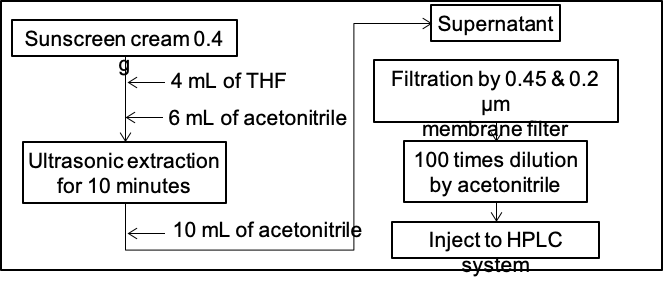
Figure 2 shows a procedure for the extraction from a sunscreen cream. Figure 3 shows chromatograms for the extract from sunscreen cream. Figure 4 shows the result of a spectral search for the peaks from the extract of sunscreen cream. The spectrum obtained for the eluted peak from cream extract was compared with spectra in a spectral library, to which the spectra for 11 standard samples had been registered in advance. It revealed a high correlation coefficient of 0.999 with the spectrum of EMC.
Keywords
920014X, HPLC, PDA detector, ultraviolet absorbers, sunscreen cream, C8, EXTREMA
Results
Figure 1-1 shows a chromatogram and a contour map for a mixture of 11 standard ultraviolet absorbers obtained using a PDA detector. Figure 1-2 shows spectra acquired at the top of different peaks.
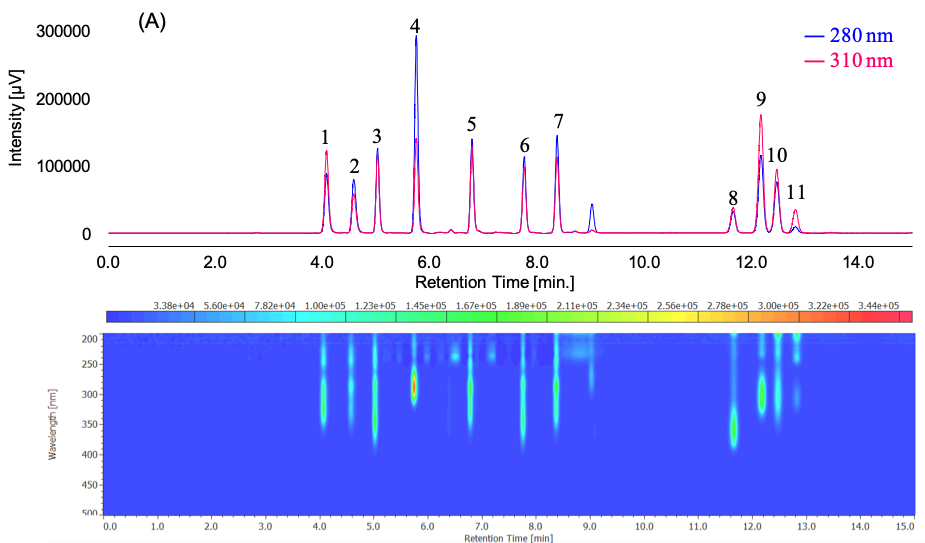
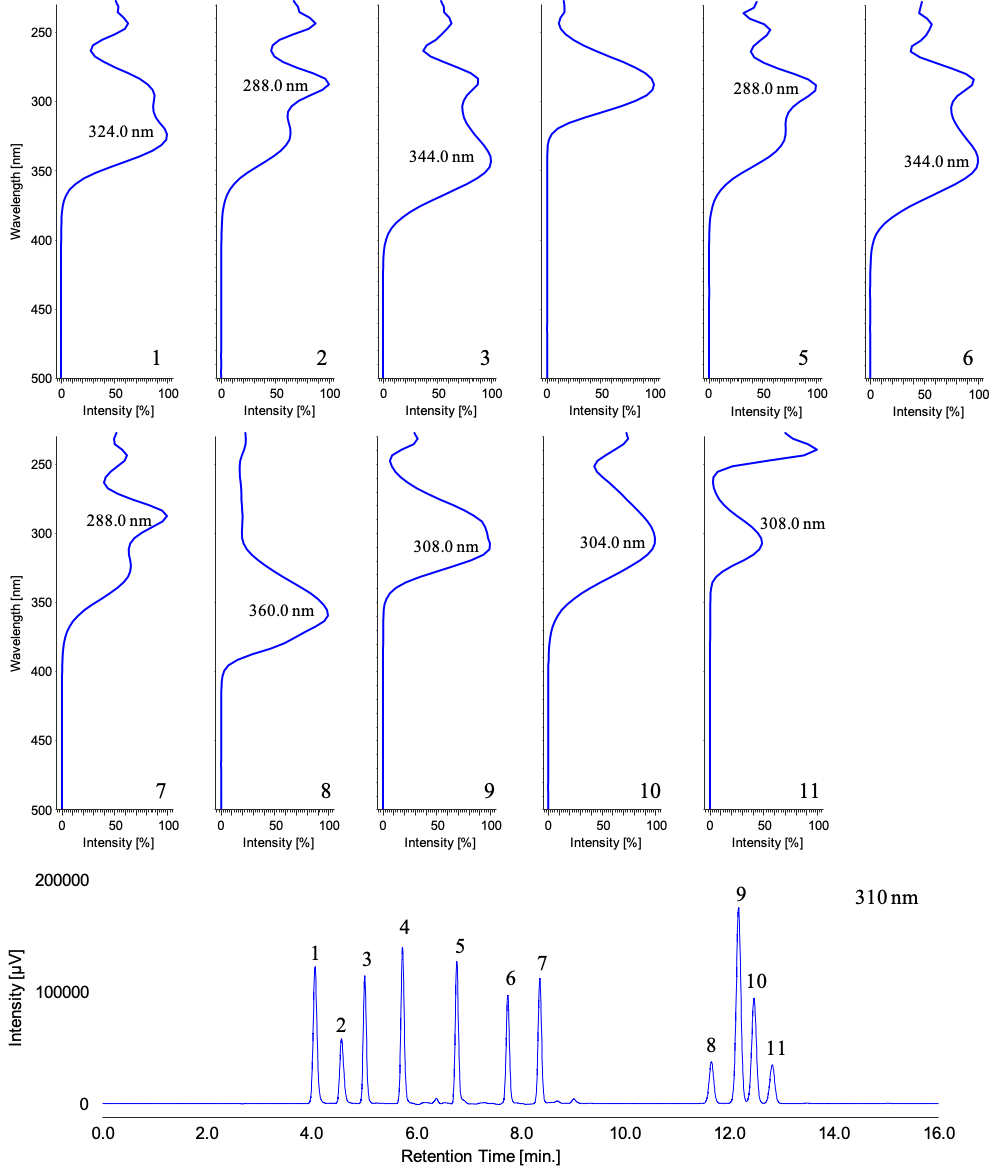
1: HMC, 2: HMBS, 3: THB, 4: EAB, 5: DHB, 6: DHDMB, 7: HMB, 8: BMB, 9: EMC, 10: ECA, 11: EHS.
Figure 2 shows a procedure for the extraction from a sunscreen cream. Figure 3 shows chromatograms for the extract from sunscreen cream. Figure 4 shows the result of a spectral search for the peaks from the extract of sunscreen cream. The spectrum obtained for the eluted peak from cream extract was compared with spectra in a spectral library, to which the spectra for 11 standard samples had been registered in advance. It revealed a high correlation coefficient of 0.999 with the spectrum of EMC.
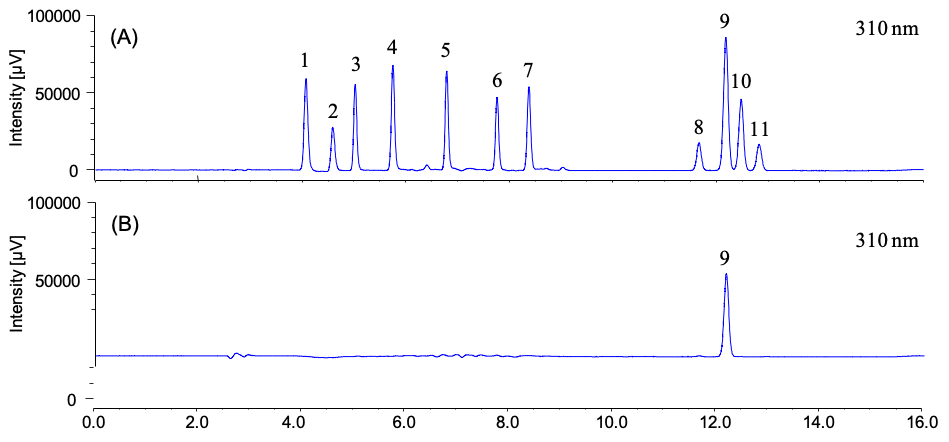
(A) Standard, (B) Extract.
1: HMC, 2: HMBS, 3: THB, 4: EAB, 5: DHB, 6: DHDMB, 7: HMB, 8: BMB, 9: EMC, 10: ECA, 11: EHS.
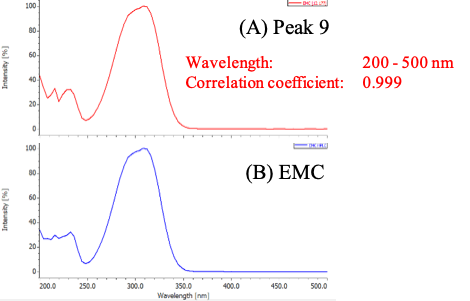
(A): Spectrum of Peak 9, (B): Spectrum of EMC.

Analysis of Ultraviolet Absorbers in Sunscreen Cream by HPLC
Introduction
In 2008, Italian scientists published their results showing that oxybenzone, benzophenone and cinnamic acid, the major components of UV absorbers, are responsible for coral bleaching (i.e., death). In 2015, results showing that the chemicals affect coral DNA even at low concentrations were published in a scientific journal of Environmental Toxicology. An ordinance that bans the sale and distribution of sunscreens containing oxybenzone (HMB) and octinoxate (EMC) was enacted in 2018 and came into effect on January 1, 2021 in Hawaii. These ordinances and bills are set to come into effect at the same time in Key West, Florida and Bonaire, the Caribbean; thus, regulations have started to be taken around the world. In Japan, however, products using these components are still sold because of the absence of such regulations, and their use is not banned either. Nevertheless, we encourage to choose UV-absorber-free or environmentally friendly products when visiting such regulated areas.
Here, we report the results of our simultaneous analysis measuring 11 components of UV absorbers contained in a commercially available sunscreen cream.
Experimental
| Instruments | |
| Pump | PU-4180-LPG |
| Autosampler | AS-4150 |
| Column oven | CO-4060 |
| PDA detector | MD-4010 |
| HPLC Conditions | |
| Column | CrestPak C8T-5 (4.6 mm I.D. x 250 mm L, 5 µm) |
| Eluent A | 1.5 % formic acid |
| Eluent B | Acetonitrile |
| Gradient | A/B = 60/40 (0.00 min.) --> 0/80 (4.00 min.) --> 10/90 (12.00 min.) --> 5/95 (12.05 min.) --> 5/95 (14.00 min.) --> 60/40 (14.05 min.), 1cycle; 22 min. |
| Flow Rate | 1.0 mL/min. |
| Column Temperature | 40 ºC |
| Wavelength | 200 - 500 nm |
| Injection Volume | 5 µL |
| Standard | 11 ultraviolet absorbers mixture in acetonitrile (Refer to the data for concentrations.) |
| Sample | Sunscreen cream (Pretreatment method is described later.) |
Figure 2 shows a procedure for the extraction from a sunscreen cream. Figure 3 shows chromatograms for the extract from sunscreen cream. Figure 4 shows the result of a spectral search for the peaks from the extract of sunscreen cream. The spectrum obtained for the eluted peak from cream extract was compared with spectra in a spectral library, to which the spectra for 11 standard samples had been registered in advance. It revealed a high correlation coefficient of 0.999 with the spectrum of EMC.
Results
Figure 1-1 shows a chromatogram and a contour map for a mixture of 11 standard ultraviolet absorbers obtained using a PDA detector. Figure 1-2 shows spectra acquired at the top of different peaks.
1: HMC, 2: HMBS, 3: THB, 4: EAB, 5: DHB, 6: DHDMB, 7: HMB, 8: BMB, 9: EMC, 10: ECA, 11: EHS.
Figure 2 shows a procedure for the extraction from a sunscreen cream. Figure 3 shows chromatograms for the extract from sunscreen cream. Figure 4 shows the result of a spectral search for the peaks from the extract of sunscreen cream. The spectrum obtained for the eluted peak from cream extract was compared with spectra in a spectral library, to which the spectra for 11 standard samples had been registered in advance. It revealed a high correlation coefficient of 0.999 with the spectrum of EMC.
(A) Standard, (B) Extract.
1: HMC, 2: HMBS, 3: THB, 4: EAB, 5: DHB, 6: DHDMB, 7: HMB, 8: BMB, 9: EMC, 10: ECA, 11: EHS.
(A): Spectrum of Peak 9, (B): Spectrum of EMC.
Keywords
920014X, HPLC, PDA detector, ultraviolet absorbers, sunscreen cream, C8, EXTREMA