
Analysis of Water-soluble Vitamins by Electrochemical Detector
April 13, 2026 Download This Application
Introduction
Water-soluble vitamins complement the functions of enzymes that are required for the metabolism in human body. They must be taken from foods as they are hardly be synthesized in the body. In recent years, growing health consciousness has driven the prevalence of many commercial products containing vitamins as nutritionally functional foods, making vitamins to attract public attention as functional ingredients.
UV detectors and fluorescence detectors are often used to detect water-soluble vitamins; however, some vitamins like biotin, which barely absorbs UV, have to be detected using short-wavelength UV. Consequently, the measurement of actual samples containing impurities is expected to be extremely difficult due to the interference from the impurities.
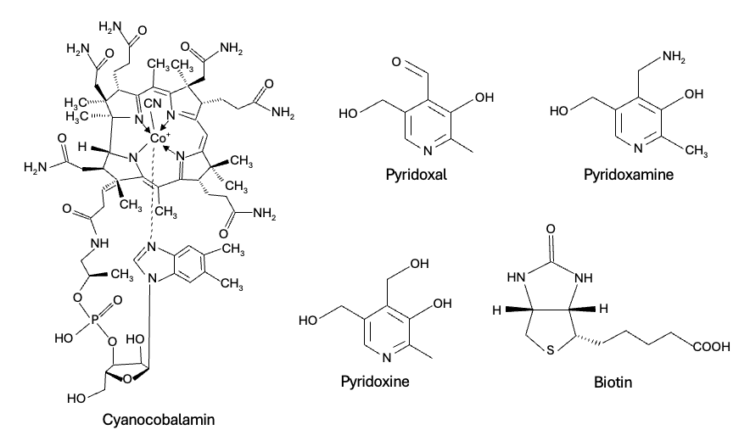
In this application note, we demonstrate the measurement of five water-soluble vitamins, including biotin, using an electrochemical detector (ED743) manufactured by GL Sciences.
Experimental
Instruments
Pump: PU-4180-LPG
Autosampler: AS-4050*
Column oven: CO-4060
EC detector: ED743
*with option units
LC Conditions
Column: Unifinepak C18 (4.6 mm I.D. x 150 mm L, 5 µm)
Eluent A: 5 mM 1–pentanesulfonic acid sodium and 0.1 % phosphoric acid in water
Eluent B: 5 mM – pentanesulfonic acid sodium and 0.1% phosphoric acid in acetonitrile/water (80/20)
Gradient: A/B = 95/5 (0 min) → 60/40 (12.00 min) → 95/5 (12.10 min), 1 cycle; 21 min
Flow rate: 1.0 mL/min
Column temp: 40 ºC
ECD condition: 1600 mV vs. Ag/AgCl (Diamond Electrode)
Injection volume: 10 µL
Standards: Cyanocobalamin, Pyridoxal, Pyridoxamine, Pyridoxine, Biotin (Refer to data for concentrations)
Keywords
Water-soluble vitamins, Unifinepak C18, high performance liquid chromatography, HPLC, electrochemical detector
Results
Figure 2 shows the chromatograms of five water–soluble vitamin standard samples that were successfully separated and detected.
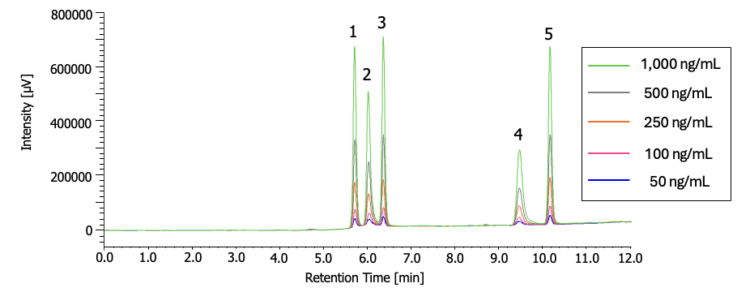
1: Pyridoxal, 2: Pyridoxamine, 3: Pyridoxine, 4: Cyanocobalamin, 5: Biotin
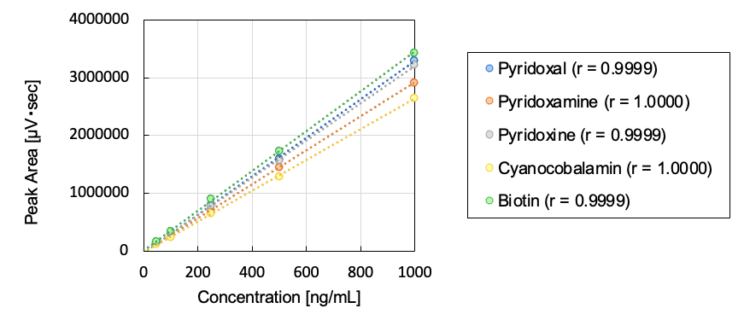
Table 1 shows the results of calculation for the linearity, reproducibility, as well as lower limit of detection and quantification for the standard samples of water-soluble vitamins. Figure 3 shows the calibration curves, confirming good linearity, reproducibility, and detection sensitivity for each water-soluble vitamin.
Table 1. Linearity, Reproducibility, Limit of Detection, and Limit of Quantitation
| Types of Catecholamines | Linearity (r) *1 | Relative Standard Deviation [%] (n = 6)*2 | Relative Standard Deviation [%] (n = 6)*2 | Limit of Detection*2 [pg] (S/N = 3) | Limit of Quantitation*2 [pg] (S/N = 10) |
|---|---|---|---|---|---|
| Retention Time | Peak Area | ||||
| Pyridoxal | 0.9999 | 0.12 | 0.61 | 38.5 | 128.3 |
| Pyridoxamine | 1.0000 | 0.12 | 1.48 | 43.1 | 143.7 |
| Pyridoxine | 0.9999 | 0.10 | 1.59 | 34.2 | 113.8 |
| Cyanocobalamin | 1.0000 | 0.02 | 1.56 | 93.1 | 310.4 |
| Biotin | 0.9999 | 0.03 | 0.39 | 36.7 | 122.2 |
*1 Range of calibration curves: 5 – 1,000 ng/mL
*2 Calculated from the measurement for each standard solution at 100 ng/mL
As a reference, Figure 4 shows a chromatogram for the standard sample of water-soluble vitamins detected by a UV detector (UV-4075) under a similar analytical condition. Table 2 shows a comparison of sensitivities between the electrochemical and UV detectors. The electrochemical detector provided more than 20 times higher sensitivity for all the five components, with more than 200 times higher sensitivity for biotin.
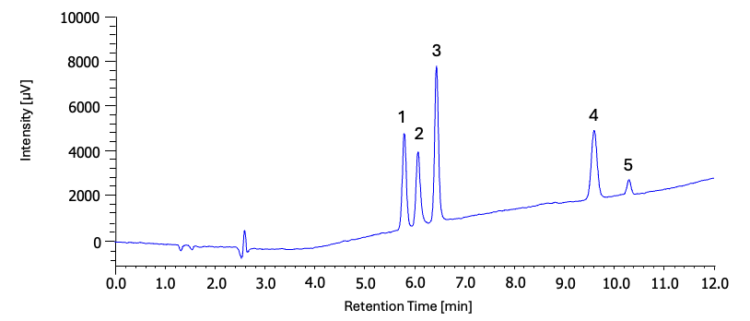
1: Pyridoxal, 2: Pyridoxamine, 3: Pyridoxine, 4: Cyanocobalamin, 5: Biotin
Table 2. Comparison of sensitivities between electrochemical and UV detectors for water-soluble vitamin standard samples
| Pyridoxal | Pyridoxamine | Pyridoxine | Cyanocobalamin | Biotin | |
|---|---|---|---|---|---|
| Electrochemical Detector Detection Limits [pg] | 38.5 | 43.1 | 34.2 | 93.1 | 36.7 |
| UV Detector Detection Limits [pg] | 1,340 | 1,730 | 829 | 1,880 | 8,400 |
| Sensitivity Comparison UV Detector / Electrochemical Detector | 34.8 | 40.2 | 24.3 | 20.2 | 229 |