
Absolute Reflectance Measurement of a Dichroic Mirror using UV-Visible/NIR Spectroscopy
February 27, 2024
 Download This Application
Introduction
A dichroic mirror is an optical element consisting of multi-layered dielectric materials that have different refractive indexes. This enables the mirror to reflect the light of a specific wavelength and transmit the light of another. Dichroic mirrors have different spectral characteristics, depending on the angle or polarization of the incident light. Therefore, in the evaluation of dichroic mirrors, it is necessary to elucidate its spectral characteristics.
An absolute reflectance accessory can be used to measure transmittance and reflection, whilst changing the incident angle and/or the polarization of the incident light. The JASCO absolute reflectance accessories orient the incident light at an angle of θ to the sample. The reflected light from the sample is then passed to an integrating sphere, where the detector angle is set as θ-2-θ (Figure 1, right). The integrating sphere can measure an absolute reflectance spectrum that cannot be obtained by relative reflectance measurement. In addition, influence from light source fluctuations is removed using a double-beam method that simultaneously transmits the reference beam to the detector in the integrating sphere.
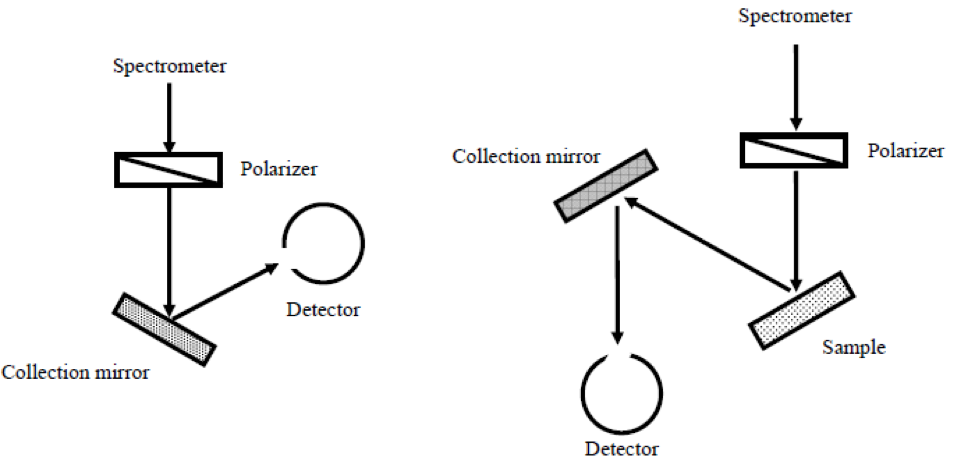
This application note demonstrates the use of an absolute reflectance measurement system that employs an integrating sphere based detector to measure the polarization and incident angle dependence and evaluate the spectral characteristics of a dichroic mirror.
Keywords
260-UV-0001, V-670, UV-Visible/NIR spectroscopy, Integrating sphere, Absolute reflectance, Materials, dichroic mirror
Results
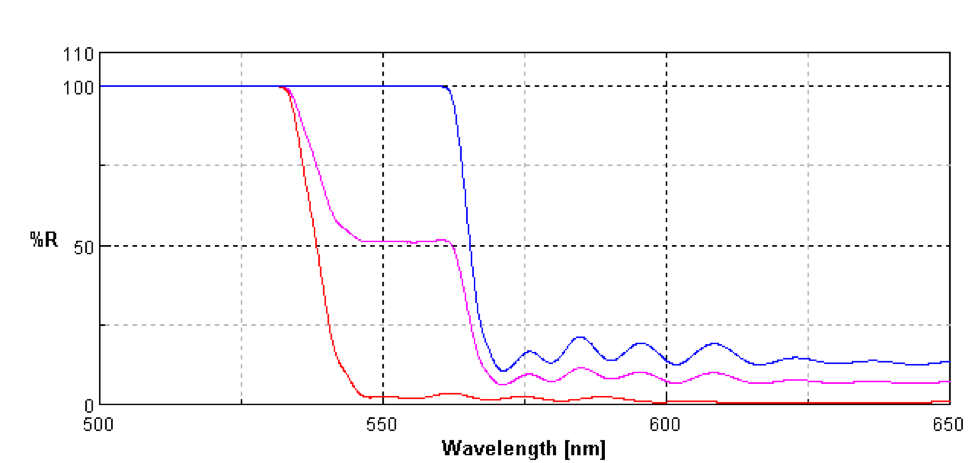
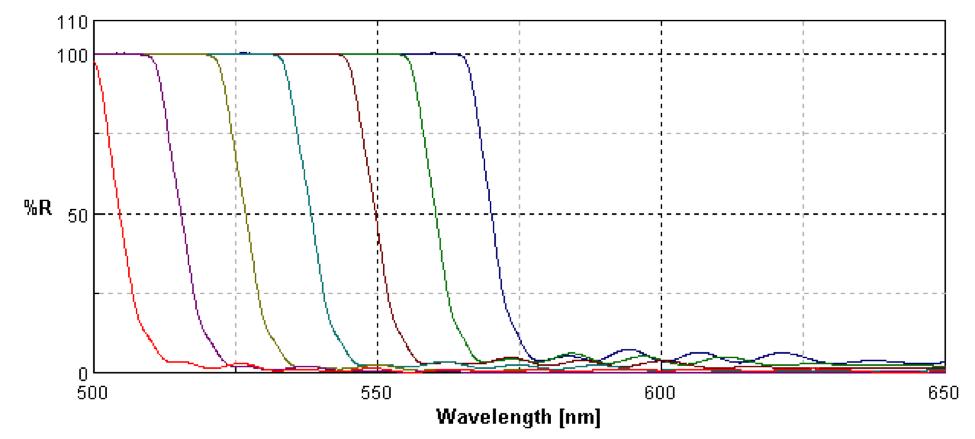
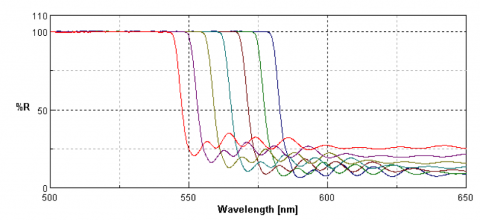
Figure 2 shows the reflectance spectrum under different polarization conditions, while Figures 3 and 4 illustrate the anglular dependence of the reflectance spectrum under the p and s polarizations, respectively. It is seen that for both s and p polarizations, the reflection region expands to the longer wavelength side with increase in the incident angle.
Featured Products:
-
A high resolution UV-Visible double-beam, double-monochromator spectrophotometer with exceptional stray light and absorbance linearity
V-760 UV-Visible Spectrophotometer
-
Wide range UV-Visible/Near Infrared Spectrophotometer with PbS detector for wavelengths up to 3200nm
V-770 UV-Visible/NIR Spectrophotometer
-
A high sensitivity UV-Visible/NIR Spectrophotometer with InGaAs detector for wavelengths up to1600nm
V-780 UV-Visible/NIR Spectrophotometer

Absolute Reflectance Measurement of a Dichroic Mirror using UV-Visible/NIR Spectroscopy
Introduction
A dichroic mirror is an optical element consisting of multi-layered dielectric materials that have different refractive indexes. This enables the mirror to reflect the light of a specific wavelength and transmit the light of another. Dichroic mirrors have different spectral characteristics, depending on the angle or polarization of the incident light. Therefore, in the evaluation of dichroic mirrors, it is necessary to elucidate its spectral characteristics.
An absolute reflectance accessory can be used to measure transmittance and reflection, whilst changing the incident angle and/or the polarization of the incident light. The JASCO absolute reflectance accessories orient the incident light at an angle of θ to the sample. The reflected light from the sample is then passed to an integrating sphere, where the detector angle is set as θ-2-θ (Figure 1, right). The integrating sphere can measure an absolute reflectance spectrum that cannot be obtained by relative reflectance measurement. In addition, influence from light source fluctuations is removed using a double-beam method that simultaneously transmits the reference beam to the detector in the integrating sphere.
This application note demonstrates the use of an absolute reflectance measurement system that employs an integrating sphere based detector to measure the polarization and incident angle dependence and evaluate the spectral characteristics of a dichroic mirror.
Results
Figure 2 shows the reflectance spectrum under different polarization conditions, while Figures 3 and 4 illustrate the anglular dependence of the reflectance spectrum under the p and s polarizations, respectively. It is seen that for both s and p polarizations, the reflection region expands to the longer wavelength side with increase in the incident angle.
Keywords
260-UV-0001, V-670, UV-Visible/NIR spectroscopy, Integrating sphere, Absolute reflectance, Materials, dichroic mirror