
Analysis of Ten Water-Soluable Vitamins in Nutritional Functional Foods
April 13, 2026 Download This Application
Introduction
Vitamins are essential micronutrients that play critical roles in metabolic processes and the maintenance of normal physiological functions. They must be obtained through dietary intake since most vitamins cannot be synthesized in sufficient quantities within the human body. In recent years, increasing health awareness has led to the widespread availability and consumption of vitamin-enriched foods and dietary supplements.
Water-soluble vitamins, including the vitamin B group and vitamin C, readily dissolve in bodily fluids, such as blood, and function primarily as coenzymes or enzyme cofactors in a wide range of metabolic pathways. Due to their importance in human health and their prevalence in commercial products, reliable analytical methods for their simultaneous determination are required.
In this application note, a HPLC method coupled with photodiode array (PDA) detection was developed for the simultaneous analysis of ten water-soluble vitamins.
Experimental
Instruments
Pump: PU-4180*
Autosampler: AS-4050*
Column Oven: CO-4060
PDA Detector: MD-4015
*with option units
SFC Conditions
Column: Unifinepak C18 (4.6 mm I.D. x 150 mm L, 5 µm)
Eluent A: 10 mmol/L sodium dihydrogen phosphate aqueous solution (adjusted to pH 2.8 with phosphoric acid)
Eluent B: Acetonitrile
Gradient: A/B = 99/1 (0.0 min) → 75/25 (10.0 min) → 75/25 (15.0 min) → 99/1 (15.1 min), 1cycle; 20 min
Flow rate: 1.0 mL/min
Column temp: 40 ºC
Wavelength: 210 nm, 260 nm
Injection volume: 20 µL
Unknown sample
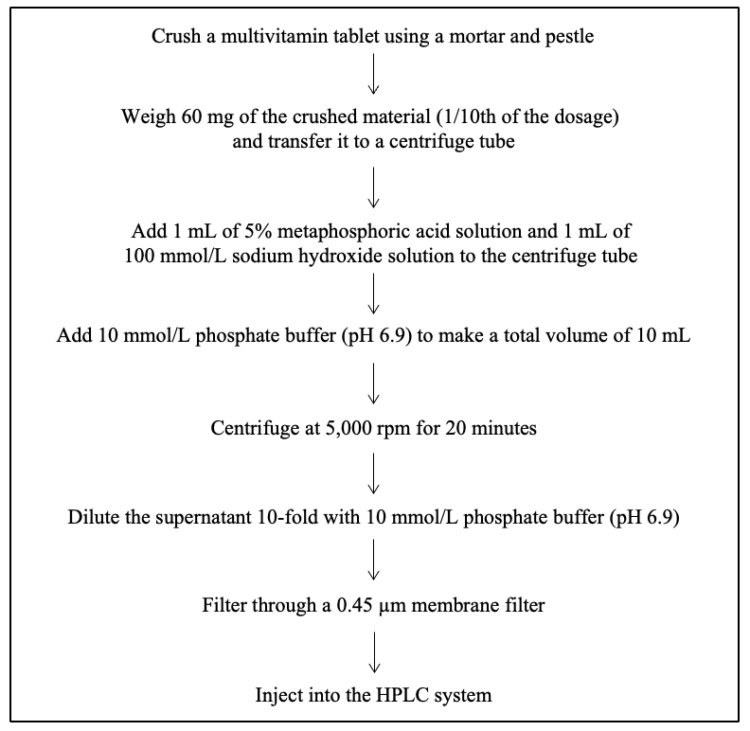
Multivitamin tablet (pre-treatment procedure shown in Figure 3)
Standard sample
Standard reagents: Pyridoxamine hydrochloride, thiamine hydrochloride, L-ascorbic acid, nicotinic acid, pyridoxal hydrochloride, nicotinamide, pyridoxine hydrochloride, calcium pantothenate, folic acid, and riboflavin
Standard stock solution:
- 10 mg of pyridoxamine, thiamine, nicotinic acid, pyridoxal, nicotinamide, pyridoxine, and pantothenic acid were each dissolved in ultrapure water and diluted to 10 mL to prepare a 1,000 mg/L stock solution.
- 10 mg of L–ascorbic acid was dissolved in a 5% metaphosphoric acid solution and diluted to 10 mL to prepare a 1,000 mg/L stock solution.
- 10 mg of folic acid and riboflavin were each dissolved in 0.5 mL of 100 mmol/L sodium hydroxide solution and diluted to 10 mL with ultrapure water to prepare a 1,000 mg/L stock solution.
Calibration solutions: Standard stock solutions were diluted with 10 mmol/L phosphate buffer (pH 6.9) to prepare calibration standard solutions at concentrations of 1.0, 2.5, 5.0, 10, and 25 mg/L.

Keywords
Water-soluble vitamins, vitamin B group, vitamin C, high performance liquid chromatography HPLC, Unifinepak, C18 column, photodiode array detector, PDA detector
Results
Figures 2 shows chromatograms of the 10 mg/L calibration standard solution containing 10 water-soluble vitamins, obtained using HPLC with PDA detection at 210 nm and 260 nm. The corresponding contour plot is shown in Figure 3, demonstrating clear spectral differentiation of the analytes. Table 1 summarizes the method performance, including reproducibility, linearity, and sensitivity. Excellent repeatability was achieved, with retention time reproducibility of ≤ 0.1% and peak area reproducibility of ≤ 2% for all analytes. The calibration curve over the range of 1.0 – 25 mg/L exhibited strong linearity, with a correlation coefficient (r) of ≥ 0.9990.
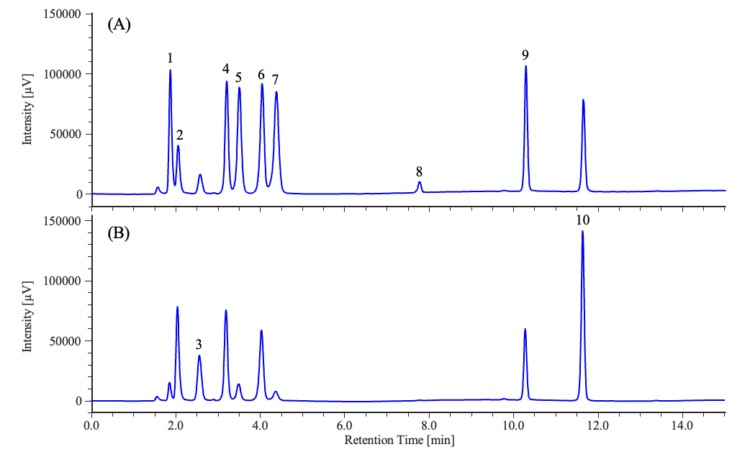
1: Pyridoxamine, 2: Thiamine, 3: L-ascorbic acid, 4: Nicotinic acid, 5: Pyridoxal,
6: Nicotinamide, 7: Pyridoxal, 8: Pantothenic acid, 9: Folic acid, 10: Riboflavin
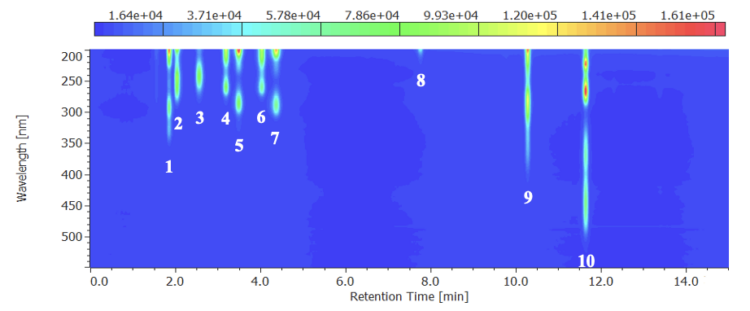
1: Pyridoxamine, 2: Thiamine, 3: L-ascorbic acid, 4: Nicotinic acid, 5: Pyridoxal,
6: Nicotinamide, 7: Pyridoxal, 8: Pantothenic acid, 9: Folic acid, 10: Riboflavin
Table 1. Reproducibility, correlation coefficient, detection limit, and quantification limit for calibration solutions
| Analysis Species | Relative Standard Deviation [%] *1 | Relative Standard Deviation [%] *1 | Correlation Coefficient (r) | Detection Limit [ng] *2 (S/N = 3) | Quantification Limit [ng] *2 (S/N = 10) |
|---|---|---|---|---|---|
| Retention Time | Peak Area | ||||
| Pyridoxamine | 0.0 | 0.94 | 0.9990 | 0.75 | 2.51 |
| Thiamine | 0.08 | 0.99 | 0.9998 | 1.20 | 3.99 |
| L-ascorbic acid | 0.07 | 1.16 | 0.9998 | 1.61 | 5.38 |
| Nicotinic acid | 0.06 | 0.82 | 1.0000 | 0.58 | 1.93 |
| Pyridoxal | 0.08 | 1.02 | 0.9999 | 0.62 | 2.07 |
| Nicotinamide | 0.08 | 0.92 | 1.0000 | 0.61 | 2.02 |
| Pyridoxine | 0.09 | 1.20 | 0.9998 | 0.69 | 2.30 |
| Pantothenic acid | 0.08 | 0.75 | 1.0000 | 4.69 | 15.6 |
| Folic acid | 0.05 | 0.69 | 0.9999 | 0.52 | 1.72 |
| Riboflavin | 0.05 | 0.61 | 0.9999 | 0.39 | 1.30 |
*1 Calculated from the measurement results for each 10 mg/L calibration solution
*2 Calculated from the measurement results for each 1 mg/L calibration solution
Figure 4 shows the pretreatment procedure for a multivitamin tablet.
Chromatograms and a contour plot of the multivitamin tablet sample are shown in Figures 4 and 5, respectively, with the quantitative results summarized in Table 2. The measured concentrations of the 6 detected water-soluble vitamin components were in good agreement with the labeled values, confirming the accuracy of the method for real sample analysis.
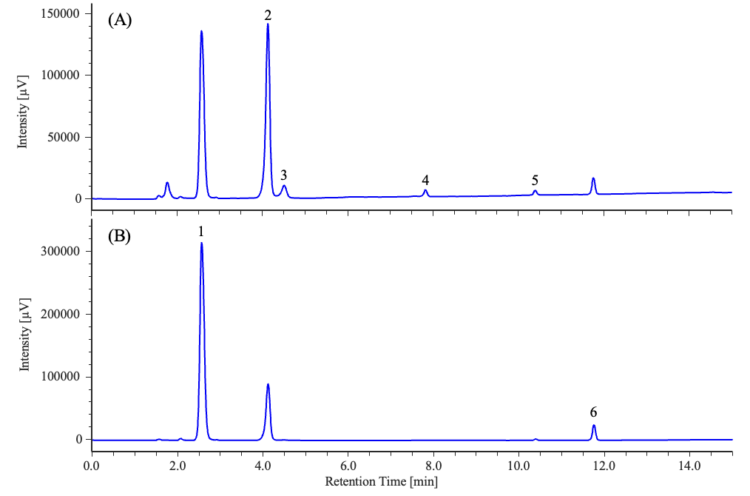
1: L-ascorbic acid, 2: Nicotinic acid, 3: Pyridoxine, 4: Pantothenic acid, 5: Folic acid, 6: Riboflavin
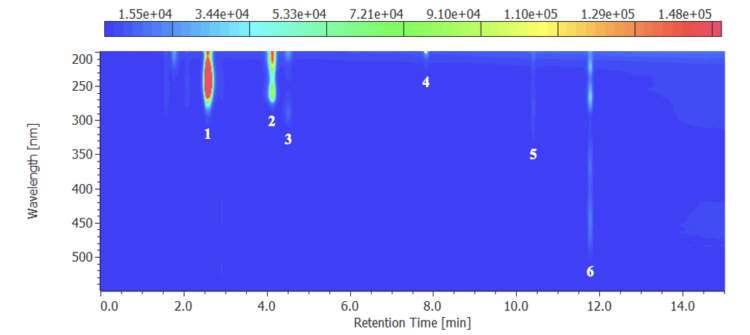
1: L-ascorbic acid, 2: Nicotinic acid, 3: Pyridoxine, 4: Pantothenic acid, 5: Folic acid, 6: Riboflavin
Table 2. Quantitative values for a multivitamin tablet
| Analysis Species | Quantitative Value [mg]* | Display Value [mg]* |
|---|---|---|
| L-ascorbic acid | 87 | 100 |
| Nicotinamide | 15 | 13 |
| Pyridoxine | 1.3 | 1.3 |
| Pantothenic acid | 4.5 | 4.8 |
| Folic acid | 0.27 | 0.24 |
| Riboflavin | 1.5 | 1.4 |
*Amount per 600 mg
Conclusion
In this application note, a robust HPLC method using a C18 column and PDA detection was successfully developed for the simultaneous analysis of ten water-soluble vitamins. The method demonstrated excellent chromatographic separation of all components, high reproducibility of retention times and peak areas, and strong linearity of the calibration curve for the standard solutions across the tested concentration range. Furthermore, application of the method to a commercially available multivitamin tablet confirmed its suitability for quantitative analysis, with measured values closely matching the label values. This application note provides a reliable and efficient method for the qualitative and quantitative evaluation of water-soluble vitamins in food and supplement products.