
Evaluation of Degradation of PA6 by Molecular Weight Distribution Measurements
April 21, 2026 Download This Application
Introduction
Nylon 6 (PA6, polyamide 6) is a widely utilized engineering polymer employed in electronic devices, mechanical components, and various industrial applications; however, PA6 is susceptible to degradation induced by environmental factors, such as ultraviolet (UV) light exposure and repeated recycling. Quantitative evaluation of the resulting changes in physical properties is therefore essential for both product development and quality control.
Gel permeation chromatography (GPC) is a standard analytical technique for characterizing polymers by determining their molecular weight distribution. In the analysis of PA6, hexafluoroisopropanol (HFIP) is commonly used as the mobile phase due to its excellent solvation properties; however, the high cost of HFIP presents a significant limitation when large solvent volumes are required. Semi-micro scale GPC offers an effective approach to reduce solvent consumption while simultaneously enabling faster analysis.
In this application note, the photodegradation behavior of PA6 was investigated using samples subjected to xenon-arc accelerated weathering. Molecular weight distributions were determined using a semi-micro scale GPC system compatible with HFIP, equipped with a refraction index detector (RI-4035) and a high-performance analytical GPC column. Data analysis was performed using the molecular weight distribution calculation function in ChromNAV. A molecular weight calibration curve was generated using polymethyl methacrylate (PMMA) standards, and the molecular weight distribution of the PA6 samples was subsequently calculated.
Experimental
Instruments
Pump: PU-4185
Autosampler: AS-4150*
Column oven: CO-4060
RI detector: RI-4035
*with option units
LC Conditions
Column: GPC LF-404 x2 (4.6 mm I.D. x 250 mm L, 6 µm)
Eluent: 5 mmol/L sodium trifluoroacetate in HFIP
Flow rate: 0.2 mL/min
Column temp: 40 ºC
Injection volume: 20 µL
Sample
Standard samples for creating molecular weight calibration curve
PMMA mixed sample
(two samples prepared for different molecular weight peaks (Mp)
Standard sample 1: Mp 772,000; 51,900; 6,900; 645
Standard sample 2: Mp 211,000; 21,700; 2,200
Each sample was dissolved and diluted in the mobile phase to 0.025 % (w/v)
Test Samples for Evaluation
PA6 test samples (approximately 2.5 mm, pellet-shaped, Standard Test Piece Co., Ltd.)

Keywords
PA6, gel permeation chromatography, GPC, molecular weight distribution, polymethyl methacrylate, PMMA, molecular weight calibration curve, hexafluoroisopropanol, HFIP, semi-micro scale, refractive index detector, RI detector
Results
Figure 2 illustrates the procedure for the photodegradation test. Light irradiation was performed using a xenon accelerated weathering tester (SOLARBOX 1500e, manufactured by Cofomegra and provided by JASCO INTERNATIONAL Co., Ltd.) at an irradiance of 60 W/m² and a temperature of 65 ºC. Three PA6 test samples were introduced at staggered intervals to achieve total irradiation times of 10 days, 5 days, and 1 day (Samples 1, 2, and 3, respectively).
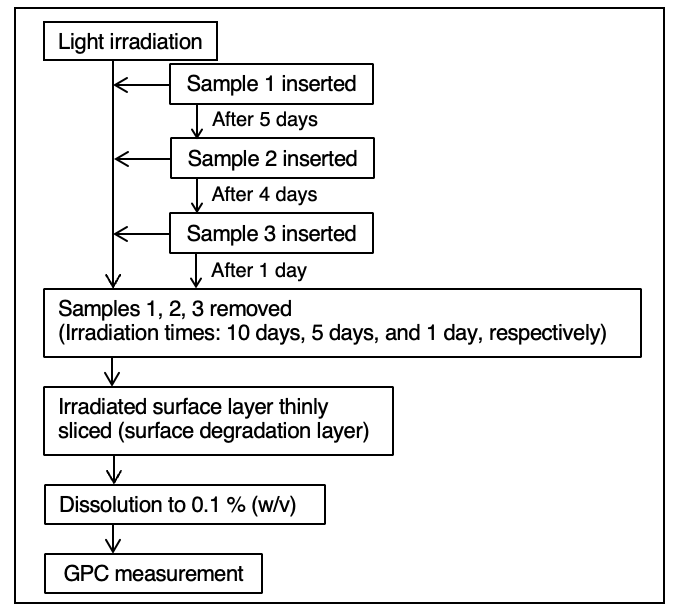
Following irradiation, the degraded surface of each sample was removed using a plane-type slicer (Slice Master KS-10, provided by JASCO Engineering Co., Ltd.). The collected material was dissolved in the mobile phase at a concentration of 0.1% (w/v) and analyzed by GPC.
Figure 3 shows chromatograms obtained for two PMMA standard samples, and Figure 4 shows the corresponding calibration curve.
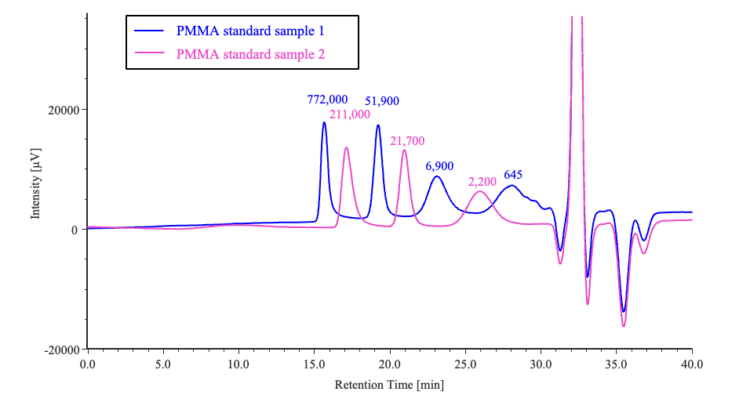
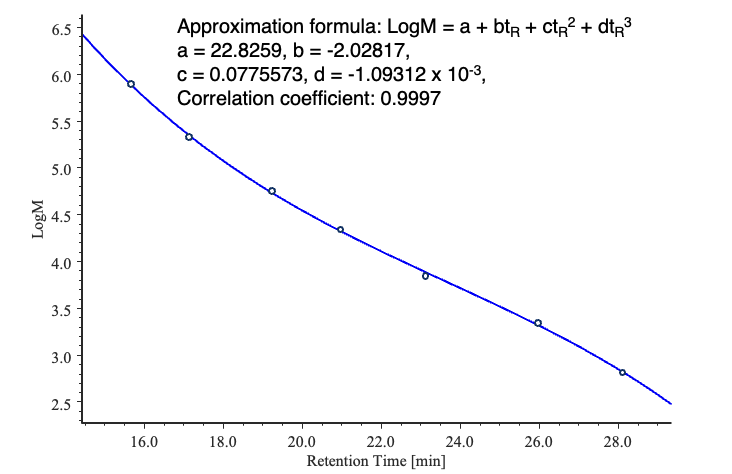
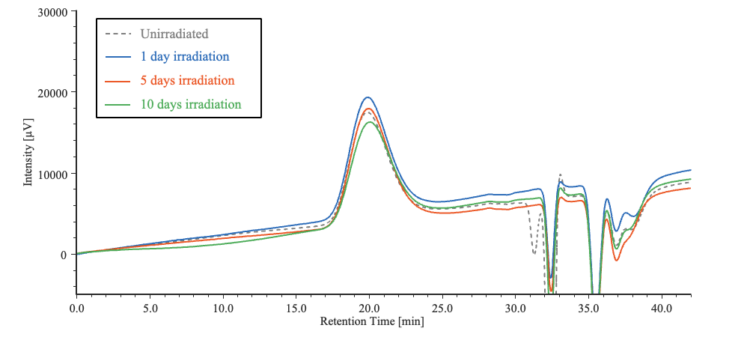
Figure 5 compares chromatograms of the irradiated PA6 samples with that of an unirradiated control sample. The corresponding differential molecular weight distribution curves are shown in Figure 6, where the horizontal axis represents the logarithm of the molecular weight to facilitate visualization of distribution changes. A clear shift in the molecular weight distribution toward lower molecular weight is observed with increasing irradiation time, indicating progressive polymer degradation.
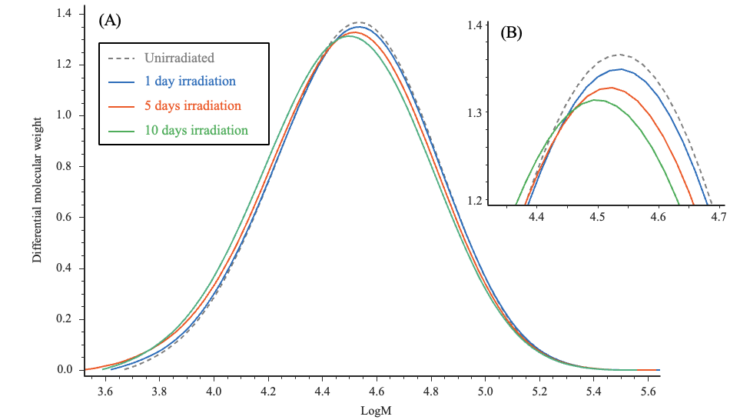
(A) Full curves (B) Enlarged view of peak tops
Table 1 summarizes the PMMA-equivalent average molecular weight calculation results. Figure 7 shows the variation of number-average molecular weight (Mn) and weight-average molecular weight (Mw) as a function of irradiation time. As the irradiation time increases, Mp, Mn, and Mw all decrease with increasing exposure duration, which is consistent with main-chain scission as the dominant degradation mechanism.¹
Table 1. PMMA-equivalent average molecular weight calculation results
| Sample | Mp | Mn | Mw | Mw/Mn |
|---|---|---|---|---|
| Unirradiated | 36,848 | 26,964 | 41,225 | 1.53 |
| 1 day irradiation | 36,510 | 26,481 | 41,150 | 1.55 |
| 5 days irradiation | 36,010 | 25,026 | 39,848 | 1.59 |
| 10 days irradiation | 34,245 | 24,434 | 38,741 | 1.59 |
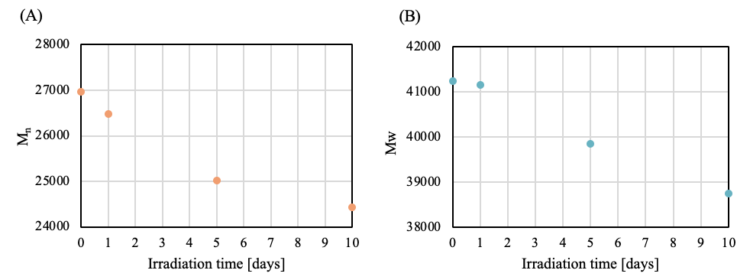
(A) Number-average molecular weight (Mn) (B) Weight-average molecular weight (Mw)
Conclusion
In this application note, the photodegradation of PA6 samples under xenon-arc irradiation was successfully evaluated using a semi-micro scale GPC system to determine the molecular weight distribution. The results demonstrate a systematic decrease in Mp, Mn, and Mw with increasing irradiation time, indicating progressive main-chain degradation. This approach provides a reliable and efficient method for the quantitative assessment of polymer degradation, while reducing solvent consumption using semi-micro scale GPC with HFIP.
References
- X. Colin, J. Verdu: C. R. Chim., 9, 1380 (2006). DOI: 10.1016/j.crci.2006.06.004