
Rapid Peptide Separation by Supercritical Fluid Chromatography
August 25, 2022
 Download This Application
Introduction
Interest in supercritical fluid chromatography (SFC) applications is growing due to its ability to reduce analysis times, organic solvent consumption and waste production. SFC is well established for small molecule pharmaceutical chiral purifications and is continually expanding into other areas. The exploration of aqueous molecules such as peptides was initially inhibited by beliefs that the successful separation of hydrophilic and polar compounds was unlikely by SFC. However, this application note illustrates the ability of SFC to separate peptides.
Experimental
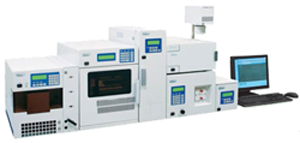
A JASCO SFC 2000 series was used for the measurement. The system consisted of a PU-2080-CO2 liquefied carbon dioxide delivery pump, PU-2080 HPLC modifier delivery pump, an LV-2080-03 solvent selection valve, an AS-2059-SF autosampler, an HV-2080-06 column switching valve (2), a CO-2060 column oven, an MD-2010 diode array detector, a BP-2080 back-pressure regulator, and EZChrom Elite data system.
The separation column was a Princeton Chromatography 2-Ethylpyrindine column (4.6 mm ID x 250 mm L, 5 µm, 60A). The standard 5 peptide HPLC mixture was purchased from Sigma-Aldrich. It contained G 3502 (GLY-TYR), V 8376 (VAL-TYRVAL), M 6638 Methionine Enkephalin Acetate (TYRGLY-GLY-PHE-MET), L 9133 Leucine Enkephalin (TYR-GLY-GLY-PHE-LEU), and A 9525 Angiotensin II Acetate (ASP-ARG-VAL-TYR-ILE-HIS-PRO-PHE) all 0.5 mgs. The sample was dissolved in 1mL of methanol with 0.2% TFA. CO2 with a modifier mobile phase of methanol with 0.2% TFA were used.
Results
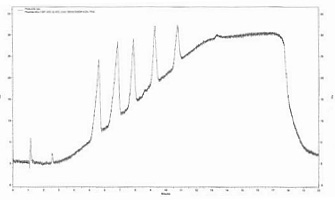
Figure 1 shows a SFC chromatogram at 230nm of the standard 5 peptide HPLC mixture. The baseline drift is clearly evident due to the increased absorbance of the methanol/TFA modifier mobile increase over the gradient elution at 230nm. This baseline drift was not seen at 254nm.
Peaks: 1 = bottle of liquefied carbon dioxide, 2 = pump, 3 = autosampler, 4 = heating coil, 5 = column, 6 = column oven, 7 = preheating coil, 8 = splitter, 9 = FID, 10 = oven for GC, 11 = cooling coil, 12 = back-pressure regulator.
The separation of this 5 peptide mixture by HPLC required nearly 60 minutes (not including column reequilibration), compared to less than 12 on SFC. The standard HPLC separation was conducted as a gradient from 5% acetonitrile with 0.1% TFA to 30% acetonitrile with 0.1% TFA over 60 minutes at 1mL/min. These HPLC conditions required 60mLs of liquid (Water-ACN) solvent producing 60mLs of waste compared to 40mLs of mobile phase (CO2-Methanol) and 16mLs of waste (including column re-equilibration) for SFC.
The resulting successful separation of a 5 peptide mixture illustrates the ever expanding ability of SFC. The analysis speed is clearly evident in the five fold decrease in analysis time and environmentally friendly nature requiring two-thirds the solvent and producing less than one-third of the organic waste.
Featured Products:
-
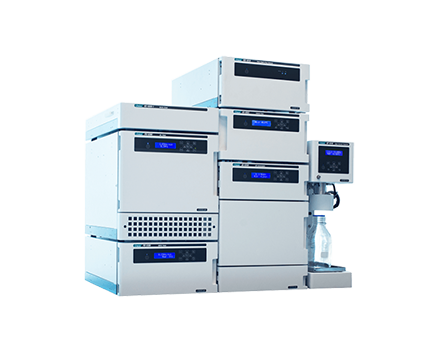
SFC-4000 Analytical SFC for routine separation to method development.
Analytical SFC System
-
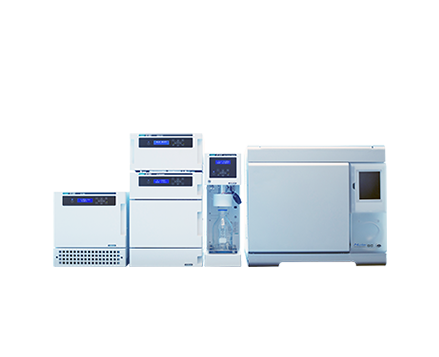
SFC-FID for Petrochemical Analysis
SFC-FID
-
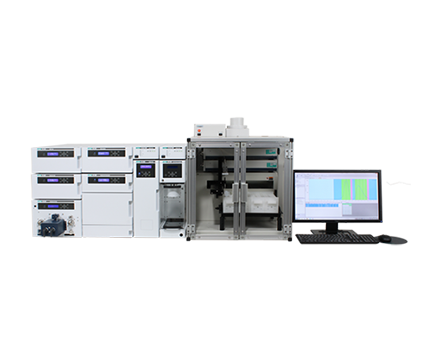
SFC-4000 Hybrid SFC for analytical and semi-preparative SFC.
Hybrid SFC System

Rapid Peptide Separation by Supercritical Fluid Chromatography
Introduction
Interest in supercritical fluid chromatography (SFC) applications is growing due to its ability to reduce analysis times, organic solvent consumption and waste production. SFC is well established for small molecule pharmaceutical chiral purifications and is continually expanding into other areas. The exploration of aqueous molecules such as peptides was initially inhibited by beliefs that the successful separation of hydrophilic and polar compounds was unlikely by SFC. However, this application note illustrates the ability of SFC to separate peptides.
Experimental
A JASCO SFC 2000 series was used for the measurement. The system consisted of a PU-2080-CO2 liquefied carbon dioxide delivery pump, PU-2080 HPLC modifier delivery pump, an LV-2080-03 solvent selection valve, an AS-2059-SF autosampler, an HV-2080-06 column switching valve (2), a CO-2060 column oven, an MD-2010 diode array detector, a BP-2080 back-pressure regulator, and EZChrom Elite data system.
The separation column was a Princeton Chromatography 2-Ethylpyrindine column (4.6 mm ID x 250 mm L, 5 µm, 60A). The standard 5 peptide HPLC mixture was purchased from Sigma-Aldrich. It contained G 3502 (GLY-TYR), V 8376 (VAL-TYRVAL), M 6638 Methionine Enkephalin Acetate (TYRGLY-GLY-PHE-MET), L 9133 Leucine Enkephalin (TYR-GLY-GLY-PHE-LEU), and A 9525 Angiotensin II Acetate (ASP-ARG-VAL-TYR-ILE-HIS-PRO-PHE) all 0.5 mgs. The sample was dissolved in 1mL of methanol with 0.2% TFA. CO2 with a modifier mobile phase of methanol with 0.2% TFA were used.
Results
Figure 1 shows a SFC chromatogram at 230nm of the standard 5 peptide HPLC mixture. The baseline drift is clearly evident due to the increased absorbance of the methanol/TFA modifier mobile increase over the gradient elution at 230nm. This baseline drift was not seen at 254nm.
Peaks: 1 = bottle of liquefied carbon dioxide, 2 = pump, 3 = autosampler, 4 = heating coil, 5 = column, 6 = column oven, 7 = preheating coil, 8 = splitter, 9 = FID, 10 = oven for GC, 11 = cooling coil, 12 = back-pressure regulator.
The separation of this 5 peptide mixture by HPLC required nearly 60 minutes (not including column reequilibration), compared to less than 12 on SFC. The standard HPLC separation was conducted as a gradient from 5% acetonitrile with 0.1% TFA to 30% acetonitrile with 0.1% TFA over 60 minutes at 1mL/min. These HPLC conditions required 60mLs of liquid (Water-ACN) solvent producing 60mLs of waste compared to 40mLs of mobile phase (CO2-Methanol) and 16mLs of waste (including column re-equilibration) for SFC.
The resulting successful separation of a 5 peptide mixture illustrates the ever expanding ability of SFC. The analysis speed is clearly evident in the five fold decrease in analysis time and environmentally friendly nature requiring two-thirds the solvent and producing less than one-third of the organic waste.