
Replacement of Synthetic Dyes in Food with Natural Colorants Using Color Matching Analysis
November 19, 2025 Download This Application
Introduction
Food Dyes are a common additive intended to make foods more appealing and uniform. For example, oranges may be greenish when fully mature, but in different growing regions they are more bright orange. To remedy this Citrus Red No. 2 is often sprayed on oranges to give them a distinct bright orange color.1 The peel of the orange is often not consumed, but food dye is also commonly applied to ingested foodstuff such as drinks, candy or prepackaged foods.
Because they are consumed, food dyes attract a strict amount of regulation. For example, since 1976 amaranth dye or FD&C No.2 has been banned by the FDA;2 Prior to this it was very common due to its low cost and lack of taste. In 2025 it was announced that the FDA intended to phase out several synthetic colorants, such as FD&C Blue No.1, Blue No. 2, Green No. 3, and more.3 Because regulations are ever evolving, industries need feasible ways to switch to new colorants while persevering the coloration of current products.
UV-Visible (UV-Vis) spectroscopy is a technique which measures the absorbance of a sample, most often a liquid sample. The absorbance of liquids is what often gives them their color, making UV-Vis spectroscopy an important tool for analyzing food dye. Color analysis has been a developing field aimed at making color comparison easier, by considering factors such as light source, time of day, angle of observation and more. To perform color analysis a UV-Vis spectrum is often processed using methods established by authorities such as the International Commission on Illumination (CIE). A color space such as the CIELAB color space, or L*a*b*, allows for easy comparison of colors by breaking UV-Visible spectra into three numbers L*, a* and b*.4 These numbers can then be used to directly compare two materials, in this case dyed food.
For the experiments described here, natural colorants were measured via UV-Vis spectroscopy and the spectra were processed with the Color Matching Analysis software to generate a library of colors. This library was then used to develop a mixture of natural colorants which best matched the color of a light blue sports drink which currently uses a synthetic dye. The natural colorant mimic was then compared to the commercially available product.
Experimental
Four commercially-available natural colorants were used to make four stock solutions in ultrapure water. Each stock was measured in a 10 mm cuvette using a UV-Vis spectrometer, and these spectra were used to create a library for color matching.
A light blue sports drink was measured in a 10 mm cell using a UV-Vis spectrometer, and the data was compared with the color library to produce a mixture of stock solutions that would best match the color values of the light blue sports drink. After this determination, stocks were mixed and the color values of the sports drink unknown and the natural colorant mimic were compared.
System
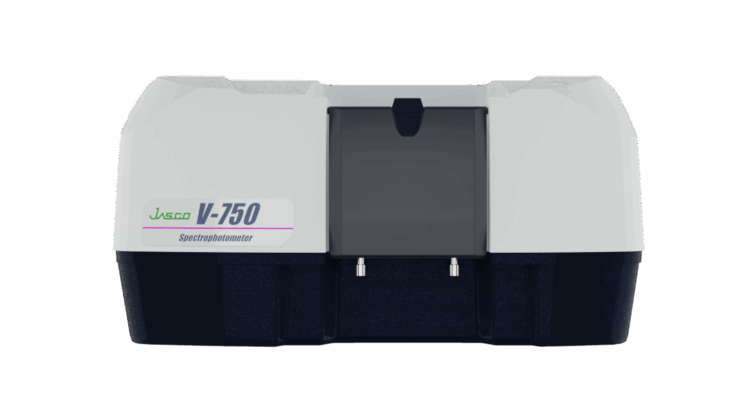
Instrument: V-750 UV-Visible Spectrophotomer
Software: VWCM-795 | Computer Color Matching Analysis
Keywords
UV-Vis spectroscopy, U.S., FDA, synthetic dye, artificial dye, natural colorant, natural color additives, food dye, color analysis
Results
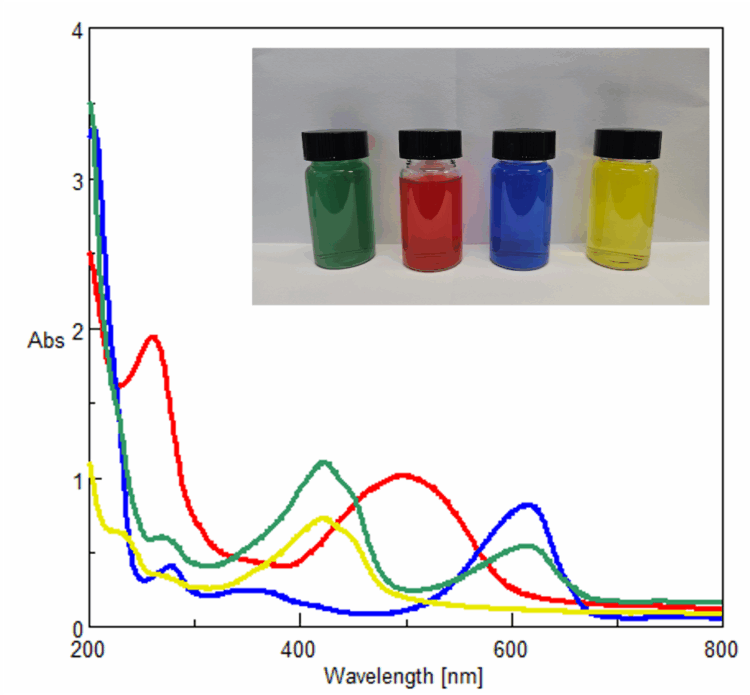
The four natural colorants had distinct UV-Visible spectra (Figure 2). A spectral library was made of the four colorants using the color matching analysis software. For each natural colorant, the concentration of the solution was supplied along with the path length and the cost per gram (Table 1).
After constructing the spectral library, the light blue sports drink was measured in the same cell and processed with the color matching analysis software. The software recommends a combination of library colorants to produce the best match to the sample. Two options for matching are available:
1. Prioritize color by minimizing the ΔE, shown in equation 1,

where c is the calculated value, T is the target color, and L*, a*, and b* are calculated color values.
2. Minimize the spectral difference between the samples.
Table 1 Natural Colorant Information
| Sample Name | Concentration(g/L) | Path Length (mm) | Cost (g-1) |
|---|---|---|---|
| Yellow | 2.184 | 10 | 0.67 |
| Blue | 2.224 | 10 | 0.67 |
| Green | 2.258 | 10 | 0.67 |
| Red | 0.559 | 10 | 0.67 |
In this study the ΔE*ab was minimized to generate a solution suggesting the colorants blue with a ratio of 0.403:1 and green with a ratio of 0.129:1, the remaining volume being water (Table 2).
Table 2 Color Library Analysis for 250 mL Solution
| Sample Name | Ratio | Dye Weight/g | Cost |
|---|---|---|---|
| Yellow | 0 | 0 | 0 |
| Blue | 0.403 | 0.224 | 0.150 |
| Green | 0.129 | 0.073 | 0.048 |
| Red | 0 | 0 | 0 |
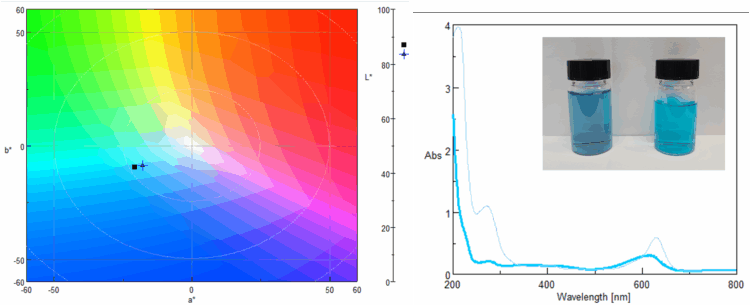
On a L*a*b* color space the predicted color of the color match solution is depicted as a crosshair and the sports drink color is depicted as a square (Figure 3a). The ΔE*ab between the two colors was calculated as 4.58. Preparing the solution as recommended yielded the natural colorant mimic which has the spectrum in Figure 3b (thick line) and is compared to the spectrum of the light blue sports drink (thin line). Note the peak broadness of the natural colorant vs. the thin line of the synthetic pigment. In the Figure 3b inset the natural colorant (left) is seen to be slightly darker than that of the sports drink (right).
Conclusion
Regulations for food are constantly evolving, particular as pertains to syntenic additives like food dye. The Color Matching Analysis program aids tremendously in determining the suitability of switching colorants, finding an ideal color match which is slightly darker a typical result for natural colorants. The complex math of color calculation and concentration correction are performed automatically with the only user input being measurement of the dyes and samples, and the inputting of dye concentration for the library.
References
- U.S. Food and Drug Administration. Regulatory Status of Color Additives: Citrus Red No.2 https://www.hfpappexternal.fda.gov/scripts/fdcc/index.cfm?set=ColorAdditives&id=CitrusRed2
- U.S. Food and Drug Administration. (1977, January 13). HHS, FDA Regulation of Food Additives [Report and Testimony]. https://www.gao.gov/products/100521
- U.S. Food and Drug Administration. (2025, April 22). HHS, FDA to Phase Out Petroleum-Based Synthetic Dyes in Nation’s Food Supply [Press release]. https://www.fda.gov/news-events/press-announcements/hhs-fda-phase-out-petroleum-based-synthetic-dyes-nations-food-supply
- J. Schwiegerling, Field Guide to Visual and Ophthalmic Optics, SPIE Press, Bellingham, WA (2004).