
Resonance Raman Scattering for Trace-Level Component Detection
March 18, 2026 Download This Application
Introduction
Raman spectroscopy is an advanced analytical technique that enables the acquisition of molecular vibrational information from a sample in a non-destructive and non-contact manner by irradiating the sample with a laser and detecting the scattered light. In general, conventional Raman spectroscopy can detect target components only when they are present at percent-level concentrations. However, many analytical applications require the identification of components present at much lower concentrations.
For example, in the analysis of pigments contained in colored plastics, the pigment content is typically as low as ~1%, while the remaining ~99% consists of polymer resin. As a result, the Raman scattering signal from the resin is overwhelmingly strong, which can mask the pigment’s spectral features and make detection difficult under conventional measurement conditions.
In this application note, we present a case study demonstrating the selective detection of trace pigment components in colored resins, components that are typically difficult to detect using standard Raman spectroscopy, by exploiting the phenomenon of resonance Raman scattering.
What is Resonance Raman?
Resonance Raman scattering is a phenomenon that occurs when the energy of the excitation wavelength is close to an electronic transition of the target component. Compared with conventional Raman scattering, the signal intensity can be significantly enhanced by more than four orders of magnitude. As a result, selective detection of specific trace components can be achieved by appropriately choosing the laser excitation wavelength used for measurement.
It should be noted, however, that the sensitivity enhancement associated with resonance effects occurs only for specific vibrational modes. Consequently, resonance Raman spectra may differ in spectral profile from those obtained under non-resonant conditions.
Applications exploiting this phenomenon include the detection of trace amounts of carotenoids and/or polyenes1) present in biological samples such as egg yolk and green-yellow vegetables, as well as the selective analysis of carbon nanotubesa) with different structures.
Experimental
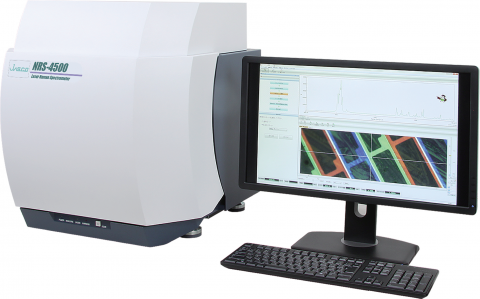
A yellow-colored resin was analyzed using the NRS-4500 laser Raman spectrometer, equipped with up to three excitation wavelengths (e.g., 457, 532, and 785 nm) (Fig. 1).
Sample
Yellow-colored polyamide pellet
Non-colored polyamide pellet
Yellow pigment
System
Instrument: NRS-4500 Raman Spectrometer
Parameters
Excitation wavelength: 457, 532, 785 nm
Objective lens: 100x
Exposure time: 2-15 sec
Accumulation: 2 times
Keywords
Raman Spectroscopy, resonance Raman scattering, trace component, pigments, dyes, conjugated structures
Results
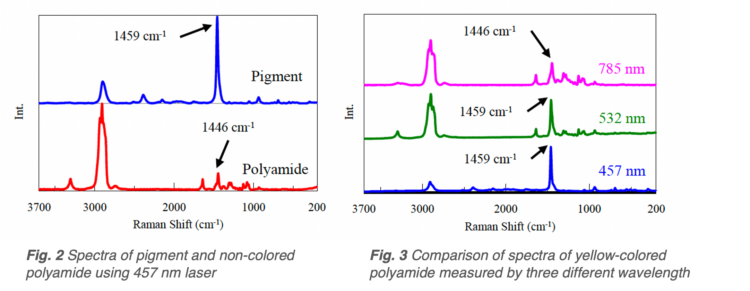
As reference, uncolored polyamide pellets and a pure pigment sample were first measured using a 457 nm excitation (Fig. 2). In both cases, well-defined spectra were obtained, and the spectral profiles were clearly distinct. The polyamide spectrum exhibited prominent bands attributable to hydrocarbon vibrations in the 3000-2800 cm-1 region and at 1446 cm-1, whereas the pigment spectrum showed a strong peak at 1459 cm-1.
Subsequently, yellow-colored polyamide pellets were measured at three different excitation wavelengths; (457 nm, 532 nm, and 785 nm). In principle, Raman scattering is independent of excitation wavelength, therefore, spectra with identical profiles would be expected. However, in this case, the three spectra with markedly different profiles were obtained depending on the excitation wavelength (Fig. 3). With 785 nm excitation, bands were observed in the 3000-2800 cm-1 region and at 1446 cm-1, and the resulting spectrum closely resembled the polyamide spectrum shown in Fig. 2. In contrast, 457 nm excitation produced a spectrum dominated by a strong peak at 1459 cm-1, which closely matched the pigment spectrum. At 532 nm, the spectral profile appeared to be a superposition of the spectra obtained at 785 nm and 457 nm.
Conclusion
By exploiting the phenomenon of resonance Raman scattering, spectral information from pigments present in trace levels in the resin, normally difficult to detect, could be obtained. Furthermore, by carefully combining measurements acquired with multiple laser wavelengths, the spectral features of the resin itself could also be selectively obtained.
Resonance Raman scattering generally occurs more readily in compounds with conjugated structures, making it a powerful tool for detecting trace components such as pigments, as well as carotenoids in foods and biological samples.
References
- M. Tsuboi, K. Tamura, R. Kitanaka, H. Oka, K, Akao, Y. Ozaki: Appl. Spectrosc., 78, 186 (2024). DOI: 10.1177/00037028231219026