Skip to content

JASCO JASCO

  • News
  • Events
  • E-Store
  • My Account
  • Contact Us
  • Worldwide
Search
Click to view menu
  • Products
    • Chromatography
      • HPLC
      • RHPLC
      • UHPLC
      • LC-MS
      • Preparative LC
      • Analytical SFC
      • Semi-Preparative SFC
      • Hybrid SFC
      • Fuel Analysis by SFC-FID
      • Preparative SFC
      • Supercritical Fluid Extraction
      • Chromatography Software
    • Molecular Spectroscopy
      • Circular Dichroism
      • High-Throughput CD
      • Vibrational CD
      • Circularly Polarized Luminescence (CPL)
      • Polarimeters
      • FTIR Spectrometers
      • FTIR Microscopy
      • FTIR Portable
      • Raman Microscopy
      • Palmtop Raman Spectrometer
      • Probe Raman
      • UV-Visible/NIR Spectrophotometers
      • UV-Visible/NIR Microscopy
      • Fluorescence Spectrophotometers
      • Film Thickness
      • Spectra Manager™ Suite
    • Refurbished
      • Refurbished HPLC Systems
      • HPLC Switching Valves
      • FTIR Accessories
  • Service
    • Service and Support Plans
    • Service Request Form
  • Applications
  • KnowledgeBase
  • Learning Center
    • Best Practice
      • Circular Dichroism Tips & Tricks for Biological Samples
      • CD Scale Calibration with ACS
      • Fluorescence Tips & Tricks
      • Raman Spectroscopy Tips & Tricks
    • Training Videos
      • ChromNAV
      • SF-NAV
      • Circular Dichroism
      • UV-Visible/NIR
      • Fluorescence
    • Training Seminars
      • Training Registration Form
    • Webinars
    • eBooks
    • Theory
      • Theory of Molecular Spectroscopy
      • Chromatography
  • About Us
    • President’s Message
    • Contact
    • History
    • Careers
  • News
  • Events
  • Worldwide
  • Shop
  • My Account
  • Contact Us

Home / Applications / Semiconductor Stress Measurement

  • Industry

  • Technique

Semiconductor Stress Measurement

By Heather Haffner

PDF IconDownload This Application

August 24, 2022

Introduction

Raman Spectrometers

<h3″>Stress evaluation of Silicon (Si)
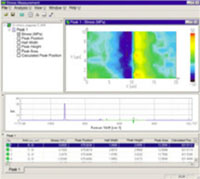
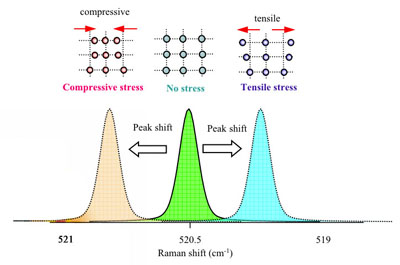
The evaluation of stress in silicon devices is extremely important in the development of next generation, high precision, highly integrated devices. Since the Raman spectrum reflects the degree of pressure dependence on the sample’s lattice vibration, it can detect stress in silicon and other semiconductors. The amount of stress is calculated from the Raman peak shift of Si. Stress-free Si has a sharp peak at around 520 cm-1. If compression stress is exerted on the crystal lattice, the lattice constant decreases and the coupling strength increases. Accordingly, the lattice vibration energy increases and the peak will shift towards higher wave numbers. When the compression is released, the peak will shift in the opposite direction to lower wavenumbers.

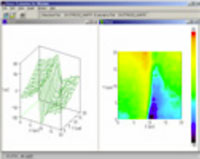
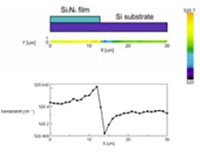
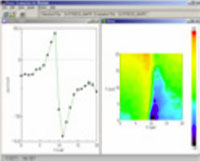
Stress distribution of a nitrided film
This document has been prepared based on information available at the time of publication and is subject to revision without notice. Although the contents are checked with the utmost care, we do not guarantee their accuracy or completeness. JASCO Corporation assumes no responsibility or liability for any loss or damage incurred as a result of the use of any information contained in this document. Copyright and other intellectual property rights in this document remain the property of JASCO Corporation. Please do not attempt to copy, modify, redistribute, or sell etc. in whole or in part without prior written permission.

Featured Products:

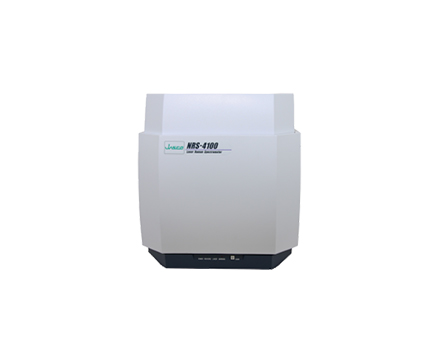
  • NRS-4100 Confocal Raman Microscopes

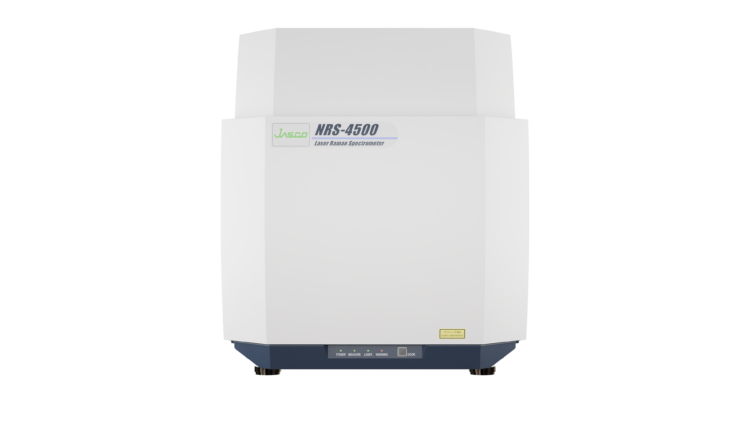
  • NRS-4500 Confocal Raman Microscope

  • NRS-5000 Series Confocal Raman Microscope

About the Author

JASCO Application Note

Semiconductor Stress Measurement

Introduction

Raman Spectrometers

<h3″>Stress evaluation of Silicon (Si)

The evaluation of stress in silicon devices is extremely important in the development of next generation, high precision, highly integrated devices. Since the Raman spectrum reflects the degree of pressure dependence on the sample’s lattice vibration, it can detect stress in silicon and other semiconductors. The amount of stress is calculated from the Raman peak shift of Si. Stress-free Si has a sharp peak at around 520 cm-1. If compression stress is exerted on the crystal lattice, the lattice constant decreases and the coupling strength increases. Accordingly, the lattice vibration energy increases and the peak will shift towards higher wave numbers. When the compression is released, the peak will shift in the opposite direction to lower wavenumbers.

Stress distribution of a nitrided film
This document has been prepared based on information available at the time of publication and is subject to revision without notice. Although the contents are checked with the utmost care, we do not guarantee their accuracy or completeness. JASCO Corporation assumes no responsibility or liability for any loss or damage incurred as a result of the use of any information contained in this document. Copyright and other intellectual property rights in this document remain the property of JASCO Corporation. Please do not attempt to copy, modify, redistribute, or sell etc. in whole or in part without prior written permission.
28600 Mary’s Court, Easton, MD 21601 USA • (800) 333-5272 • Fax: (410) 822-7526 • jascoinc.com/applications

Close

Designed in Tokyo. TRUSTED globally.

View our support plans

Connect with JASCO

  • Facebook
  • Twitter
  • LinkedIn
  • JASCO Sales
  • 800-333-5272

Receive the latest promotions and special offers

  • This field is for validation purposes and should be left unchanged.
  • Careers
  • Press Kit
  • JASCO Privacy Policy
  • Sitemap
  • Environmental Policy

© , JASCO. All Rights Reserved.