
Using a 785nm laser to reduce fluorescence in Raman analysis of a contaminant in a film
August 23, 2022
 Download This Application
Introduction
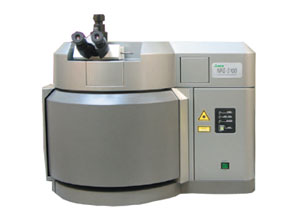
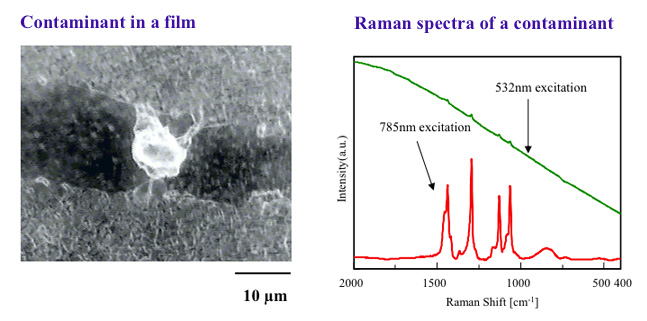
Fluorescence is an undesirable side-effect found in Raman measurement and various techniques have been developed to eliminate it or minimize its effects. One practical and effective technique is to use a longer wavelength laser that does not induce fluorescence. Recently, demand has been increasing for impurity analysis at micron resolution, which cannot be performed using infrared light. The NRS-3000 series offers measurement of samples which may fluorescence with greater sensitivity by using a 785 nm solid-state laser and optimizing optical elements, such as the beam splitter, for the near-infrared region. The figure below shows an example of measurement using an excitation at 785 nm for a sample with fluorescence. The strong background observed with a green laser obscures the Raman signal, whereas using 785 nm the excitation is outside of the fluorescence range, which allows the measurement of a good Raman spectrum.
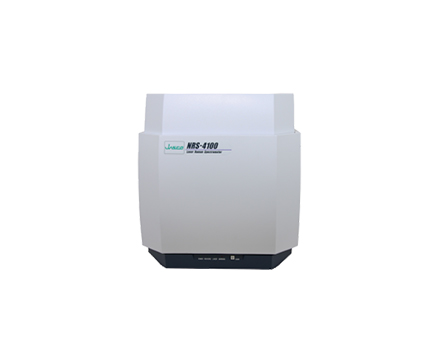
Featured Products:

Using a 785nm laser to reduce fluorescence in Raman analysis of a contaminant in a film
Introduction
Fluorescence is an undesirable side-effect found in Raman measurement and various techniques have been developed to eliminate it or minimize its effects. One practical and effective technique is to use a longer wavelength laser that does not induce fluorescence. Recently, demand has been increasing for impurity analysis at micron resolution, which cannot be performed using infrared light. The NRS-3000 series offers measurement of samples which may fluorescence with greater sensitivity by using a 785 nm solid-state laser and optimizing optical elements, such as the beam splitter, for the near-infrared region. The figure below shows an example of measurement using an excitation at 785 nm for a sample with fluorescence. The strong background observed with a green laser obscures the Raman signal, whereas using 785 nm the excitation is outside of the fluorescence range, which allows the measurement of a good Raman spectrum.