






UV-Visible/NIR

UV-Visible/NIR Spectrophotometers

V-700 Series

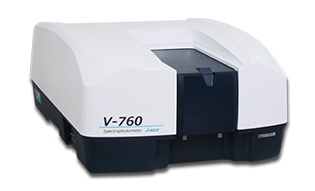
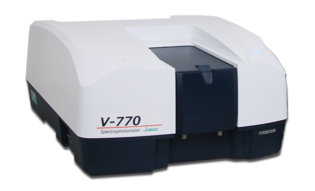
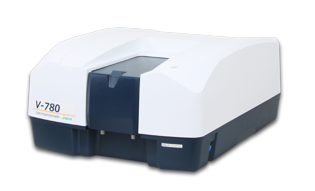
The V-700 Series comprises of five individual models covering the entire spectrum from the far-UV (187 nm) to the NIR (3,200 nm).

The V-700 Series

The V-700 Series of UV-visible/NIR spectrophotometers has been developed to cover every aspect of routine and research measurement, flexible, durable and easily maintained. The user can take full advantage of Spectra Manager, the most well developed software suite, which makes measurements simple and intuitive, and with the broadest range of analytical tools to get the most information out of any data. Each of the five models in the V-700 Series covers application across the entire measurement range of the far-UV to visible to near infrared, with the widest rage of accessories and measurement applications software to cover absorption (transmission) and reflectance (diffuse and specular) with control for temperature and time-based measurement.

What is a UV-Visible Spectrophotometer?

UV-Visible (UV-Vis) spectrophotometers measure how much ultraviolet (190–400 nm) and visible (400–700 nm) light a sample absorbs or transmits to determine concentration via the Beer–Lambert law (A = εlc). Core components include UV (deuterium) and visible (tungsten/halogen) light sources, a monochromator to select wavelength, a cuvette/sample holder, and sensitive detectors (Si photodiode, PMT, PbS, InGaAs).
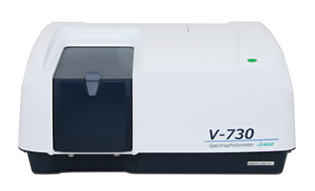
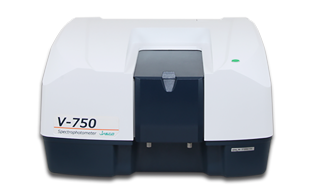
Compact Design

The compact optical design of the V-700 Series of UV-visible/NIR spectrophotometers significantly reduces the requirement for bench space in the modern laboratory.

Wide Wavelength Range

High energy throughput provides excellent signal-to-noise ratio for the entire UV-visible/NIR spectral range, with detectors selected for the highest sensitivity and dynamic range.

Excellent Optical Performance

Sophisticated electronic and optical design reduces stray light for highly accurate measurements over a wide photometric range.

High Speed Scanning

High throughput optics and fast detectors provide high-speed scanning without wavelength tracking errors.

Dark Correction

Stray light reduction ensures highly-accurate measurements of  highly-absorbing or low reflectivity materials that approach 0% reflection or transmission.

Monochromator Scanning

Continuous or step scan provides reliable peak assignment of samples with sharp or narrow absorption peaks.

User-Friendly

Spectra Manager™ Suite for Windows  and iRM hand-held controller for comprehensive control, acquisition, and data processing.

Accessory Recognition

Automatic accessory recognition matches the measurement program to the attached sampling accessory.

Automatic measurement Start

For routine operation, a measurement method can be activated with a simple push of the ‘Start Button’, great for routine operation or speeding up measurement for multiple users.

Measurement and Sampling Accessories

A comprehensive selection of over 50 sampling accessories for gas, liquid, and solid samples are available for many dedicated sampling applications.

Regulatory Compliance

For GxP compliant laboratories, instrument validation protocols to USP, EP, and JP are included as standard. IQ/OQ is also available. For laboratories that need to make electronic submission to the US federal government, Spectra Manager CFR has been developed under ALCO+ to ensure it meets the provisions of 21 CFR part 11.

FAQ


– What is the difference between a general spectrophotometer and a UV-Vis spectrophotometer?

A spectrophotometer is a broad category of analytical instrument that measures how much light a sample absorbs or transmits across a range of wavelengths. Spectrophotometry can be performed anywhere in the electromagnetic spectrum, from ultraviolet (UV) to visible, near-infrared (NIR), mid-infrared, or beyond, depending on the design and detectors used.

A UV-Visible spectrophotometer is a specific type of spectrophotometer optimized to measure light absorption and transmission in the ultraviolet (UV) and visible (Vis) regions of the spectrum, typically from about 190-900 nm; many modern instruments such as JASCO’s V-770 or V-780 models extend into the near-infrared (NIR) as well.

Key distinctions include:

  • Wavelength Range — A UV-Visible spectrophotometer focuses on the UV and visible range where many molecular electronic transitions occur, while a general spectrophotometer can cover other regions depending on its design.

  • Light Sources — UV-Vis instruments typically use a combination of deuterium lamps for the UV region and tungsten or halogen lamps for the visible region. A general spectrophotometer tailored for other spectral regions may use different sources (for example, infrared lamps for mid-IR).

  • Applications — UV-Vis spectrophotometry is widely used for quantitative analysis of chemical species in solution, concentration measurements, reaction monitoring, and material characterization. Broader spectrophotometric systems can be tailored to other applications depending on the spectral region of interest.

 – What spectral bandwidths are available for each V-700 model, and are they fixed or selectable?

V-730 offers a fixed 1 nm bandwidth; V-750 and V-760 provide selectable bandwidths (0.1, 0.2, 0.5, 1, 2, 5, 10 nm) for method flexibility; V-770 and V-780 include the same narrow UV-Visible bandwidths and NIR bandwidths of 0.4 to 40 nm.

 – What light sources are used in each model and what is their typical lifetime?

The UV range is covered by a deuterium lamp while the visible is covered by a tungsten/halogen light-source. Both have lifetimes of approximately 1000 hours.

 – Do the instruments support standalone operation with local control and data export without a PC?

The iRM hand‑held controller enables full local control, method execution, and data review. Data can be saved locally and exported to external media or transferred to Spectra Manager on a PC.

 – What are the photometric accuracy and repeatability specifications for QA/QC environments?

The V-700 series offers excellent photometric accuracy. +- 0.0015 Abs on V-730, 750, 760, and 770 from 0 to 0.5 Abs. V-780 offers an excellent +- 0.0005 Abs from 0 to 0.5 Abs. Consult model specifications for more details.

Peer-Reviewed Articles